No time to read the Must-Read: Listen to the one-minute summary.
Some books tell you how to market better. This one tells you why most companies are measuring success wrong.
Be a Sequoia, Not a Bonsai: The Seven Growth Secrets of the World’s Most Successful Companies is an urgent reading for distributors and manufacturers because it reframes growth not as chasing more customers, but as protecting and expanding the right ones.
Nicolas Darveau Garneau (Google’s former Chief Evangelist) argues that efficiency metrics make businesses look tidy but fragile – while true growth comes from thinking like a sequoia: imperfect in the short term, but built for long-term profitable expansion.
Quick Summary
Be a Sequoia, Not a Bonsai is a growth strategy philosophy, not a marketing book. Using real business cases, the author builds a compelling case that most companies are optimizing for the wrong things.
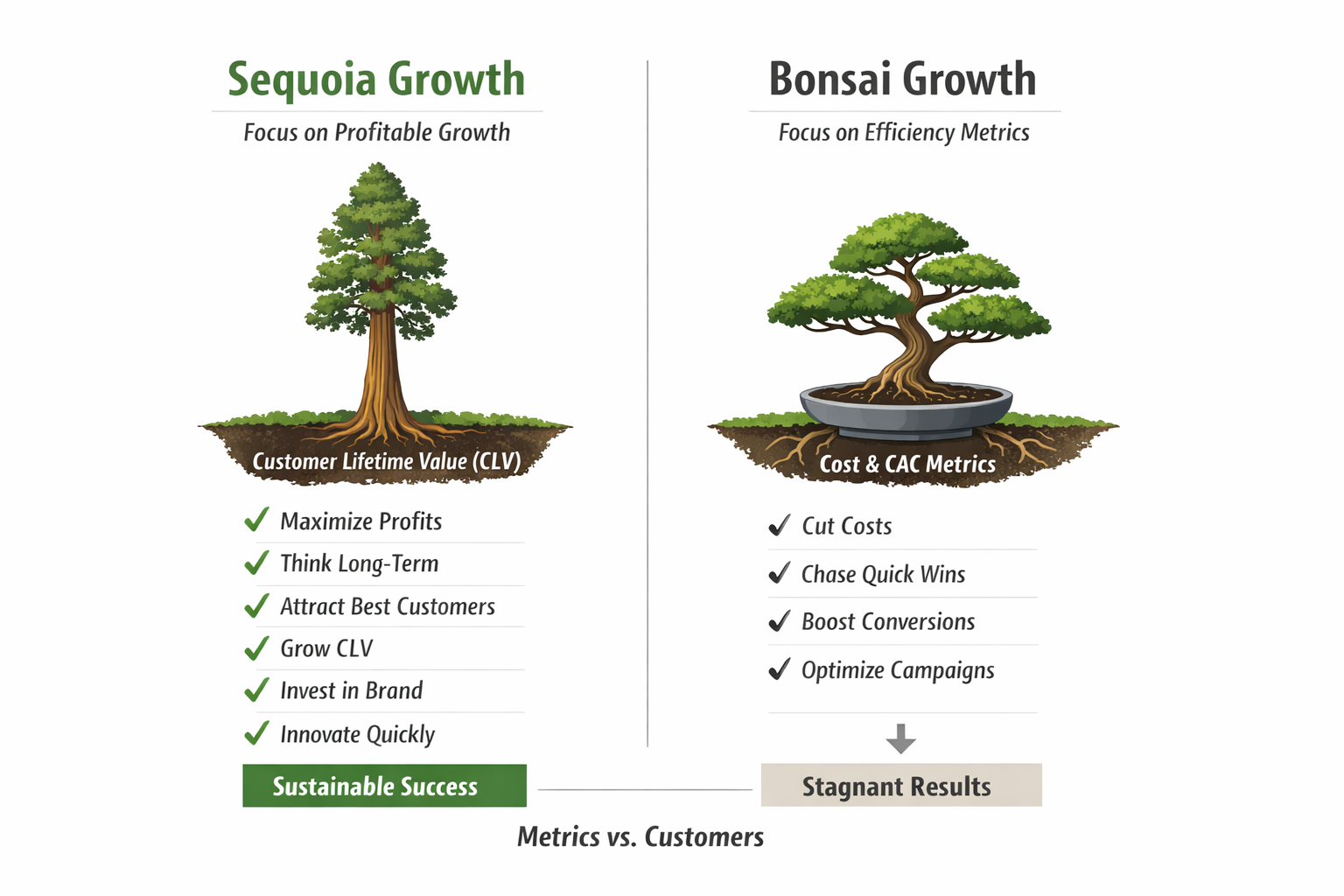
The central metaphor is the book’s thesis: bonsai companies are carefully pruned, efficient, and impressive-looking, but remain fragile and small.
Sequoia companies don’t chase perfection—they focus on steady, long-term growth. They prioritize Customer Lifetime Value (CLV), concentrate on the customers who drive the most profit, and keep improving through continuous experimentation.
The author offers practical five-step processes in each chapter — from maximizing profitable growth to acquiring high-CLV customers and improving CLV of existing ones.
Key Takeaways
1. Stop Optimizing for Efficiency. Start Optimizing for Profit
Efficiency metrics like Customer Acquisition Cost (CAC) and Return on Ad Spend (ROAS) can make a branch look good while draining margins. For distributors, the real Key Performance Indicator (KPI) is profit — across all channels combined.
2. Make CLV Your Operating Metric
The book’s central shift is from first-sale thinking to future-profit thinking.
That matters in distribution because the account that orders small but often may be far more valuable than the one-time big buyer.
3. Acquire Better Customers, Not More
Top 20% of customers often generate 150% of profits, while the bottom erodes them. Branch managers should prioritize industries and accounts with recurring demand, not chase volume.
4. Protect Against Silent Customer Loss
High-value customers often slip away gradually — smaller orders, delayed purchases, less digital activity. Customer Lifetime Value (CLV) analysis gives early warning signals before revenue collapse.
5. Expand Existing Accounts Aggressively
Most companies over-invest in acquisition. The book shows how upselling, cross-selling, and multi-category engagement drive deeper profitability.
6. Customer Experience (CX) Beats Competitive Pricing Every Time
Customers don’t leave because of price—they leave because of poor experience, with 44% of B2B buyers switching vendors for that reason. In contrast, customers who use eCommerce, self-service, and digital ordering are easier to serve, stay longer, and deliver higher long-term value.
7. Test Faster Than Competitors
Sequoia companies experiment rapidly. For distributors, this means piloting new pricing models, loyalty programs, or digital workflows in small markets, then scaling what works.
Memorable Quote
“The ability to get better at getting better is often the most sustainable competitive advantage for an organization, much like it is for living organisms.” – from the book
Application for Manufacturers & Distributors
For US distributors, the book’s lessons cut straight to daily reality. CLV isn’t abstract — it tells you which contractors or accounts actually matter, and which ones quietly drain profit. It reframes sales prioritization, pricing, and marketing spend around long-term profitability.
Manufacturers selling through distribution can use these insights to strengthen channel relationships, ensuring their products reach high-value accounts with predictable demand.
Whether it’s ERP-first integration, branch operations, or customer service, the message is clear: stop chasing every customer, and start protecting the ones who drive real profit.
Visual Takeaway
DCKAP Insights (For Manufacturers and Distributors)
CLV Is the Distributor’s North Star
The book insists CLV is the real competitive advantage. For distributors, this means shifting from “cost per lead” to “profit per customer segment.”
Integration as a Growth Engine
At DCKAP, we see system integration not as backend plumbing, but as a direct driver of Customer Lifetime Value (CLV). When ERP, eCommerce, CRM, PIM, and other systems work together, distributors can deliver real-time inventory accuracy and shipment visibility—exactly what high-value customers expect and rely on to stay loyal.
Why This Book Matters Now
Margins in distribution are under pressure, and digital competitors are pulling away high-value accounts. This book argues that the real danger isn’t poor marketing, but invisible customer loss.
By focusing on Customer Lifetime Value (CLV), distributors can forecast revenue more accurately, protect against churn, and invest confidently in digital systems.
In a supply chain landscape where customer expectations are rising, Garneau’s framework is a survival guide.
Who Should Read It
Branch managers who need to prioritize profitable accounts. Operations leaders tasked with improving customer retention.
SMB distributors competing against eCommerce giants. Procurement and sales directors who want to align pricing and discounts with long-term profitability.
Manufacturers who depend on distribution channels and want to ensure their products reach the right customers.

About Author
Nicolas Darveau Garneau (Google’s former Chief Evangelist) is the author of Be a Sequoia, Not a Bonsai. Drawing from his extensive experience of working with more than one thousand CEOs and CMOs, he distills lessons on growth strategy, customer profitability, and digital-first branding into practical frameworks for business leaders.

About the Curator:
Tamizh Selvan Dinakaran has over 25 years of experience helping businesses grow through digital marketing, particularly in the distribution and manufacturing sectors. He currently leads customer education at DCKAP, where he creates programs designed to help customers succeed in deriving value from DCKAP’s products. Previously, as DCKAP’s Director of Marketing, he focused on increasing brand awareness and generating leads through effective content marketing. Tamizh specializes in B2B content marketing, marketing operations, and customer success.
Read More Book Reviews

ERP Integration made simple for Manufacturers & Distributors.
Transform your commerce journey by creating an integrated experience for employees and customers.