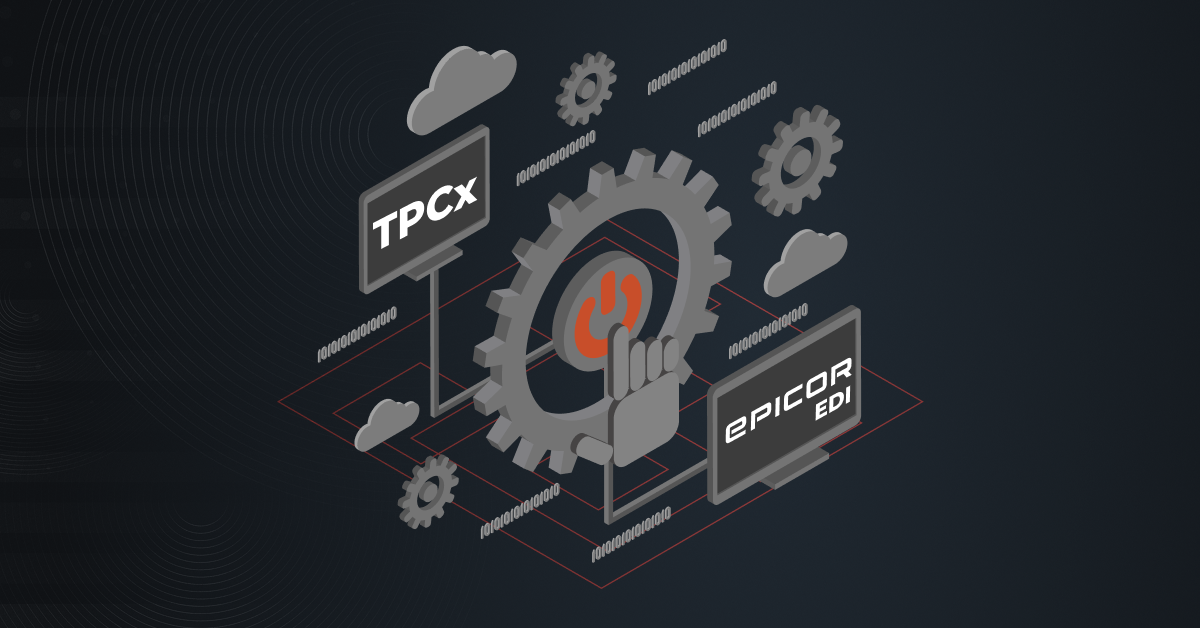
You may have already heard the news. Epicor plans to sunset TPCx (Trading Partner Connect) by December 2026. It’s not a sudden move, and honestly, it’s been coming for a while. TPCx has served its purpose well, but the legacy architecture makes it tough to keep up with the security and reliability standards businesses expect today.
Epicor EDI will take its place, which means it’s time for users to think about what comes next. Let’s walk through the shift and explore better alternatives.
TCPx Vs. Epicor EDI: What’s New
TPCx served Epicor users well for years, especially in Prophet 21. It handled the basics of EDI like sending and receiving documents like POs, invoices, and ASNs. But it was built on older architecture, and that limited how far it could go.
Epicor EDI is the modern replacement. It’s designed for automation, visibility, and cloud-ready workflows. Instead of just moving data from point A to point B, it gives businesses deeper insight and stronger control over their supply chain.
How TPCx and Epicor EDI Differ
TPCx (Legacy)
- Focused mainly on exchanging documents
- Limited automation and visibility
- Built for older Epicor systems, including Prophet 21
- Narrower format support
- Less flexible for scaling and modern integrations
Epicor EDI (Modern)
- Designed for Epicor’s newer platforms, including Kinetic
- Real-time visibility through a web portal
- Built-in alerts and reporting tools
- Supports AS2, SFTP, FTP, and other modern protocols
- Works with more formats like EDIFACT and cXML
- Offers API-based and SQL-based integration
- Optional managed services for continuous support
This Shift Was Necessary:
- To automate more processes and reduce manual work
- To give users better insight into supply chain activity
- To integrate cleanly with modern cloud ERPs
- To keep pace with faster, more connected business operations
Also read: The Ultimate Epicor Automation Studio Guide [+ Best Alternative for Distributors and Manufacturers]
DCKAP EDI: A Smarter Alternative For Broader Business Needs
While Epicor EDI is the official path forward, many businesses want something simpler to manage. DCKAP EDI, on the other hand gives you the same EDI capabilities but in a way that removes a lot of the difficult work that usually comes with EDI work.
Here’s why it stands out:
1. One Platform for Everything
- EDI translation, mapping, and integration, all inside a single system.
- No switching between tools.
- No separate or disconnected processes.
- Just one place to build, run, and monitor all your workflows.
This makes onboarding, troubleshooting, and scaling so much easier. When everything flows through one engine, nothing is missed out.
2. Deep Epicor Experience
- DCKAP is built and backed by years of experience of the Epicor ecosystem including that of Epicor Prophet 21, Eclipse, Kinetic, and others.
- It even has its own Epicor-specific APIs.
- And beyond Epicor, it has years of experience connecting dozens of major ERPs preferred by distributors and manufacturers.
So when something needs to sync, connect, or translate, it’s handled by people who understand the environment. That means fewer delays, less back-and-forth, and no guesswork. And honestly, that background makes all the difference when you just want something that simply works.
3. Support You Can Rely On
- You’re not left on your own after setup.
- A dedicated team monitors and manages everything.
- They spot issues early and fix them before they escalate.
- You get help from people who actually understand your system
It feels more like having an extension of your internal team than an outsourced service.
4. Transparent Pricing
- There’s no mystery around cost.
- Clear pricing.
- Predictable billing.
- No surprise fees later.
You always know what you’re paying for, which makes budgeting easier and prevents those typical “integration shock” moments many companies run into. Here’s a quick comparison between your options:
| Key Features | Epicor EDI | DCKAP EDI |
| Best fit for | Epicor-centric EDI | EDI + Full integration across systems |
| Native EDI support | Yes | Yes |
| EDI Translation & Mapping | Built-in | Supported (no separate tool needed) |
| Integration capabilities | Limited to Epicor ecosystem | Universal integrations (ERP, CRM, WMS, eCommerce, Marketplaces etc) |
| Managed service option | Optional (additional) | Fully managed as a standard offering |
| Flexible Document Format Support | X12 | X12, XML, EDIFACT |
| Custom workflows | Yes (within Epicor) | Yes (across systems) |
| Ease of deployment | Medium | Easy, streamlined onboarding |
| Pricing transparency | Varies, can be complex | Clear, transparent pricing. Starting from $2499 /month, billed annually |
| Overall complexity | Moderate | Low, managed single platform |
| User Experience | Standard | Modern, intuitive interface |
So, If you want a cleaner, simpler, fully managed way to handle EDI and integration, check out DCKAP.
Also read: EDI Transactions & EDI Integration: A Step-by-Step Manual for Seamless Operations
Why Waiting Now Could Cost You Later
It’s easy to look at the December 2026 deadline and think there’s plenty of time. A year feels like a long runway. But waiting comes with its own set of problems.
As support for TPCx winds down, the help available to you will slowly shrink. Teams that wait too long often run into crowded schedules, fewer migration resources, and tighter deadlines. That’s when mistakes happen. And when timelines get compressed, automated EDI is more likely to be disrupted.
Starting early gives you space to move at your own pace. You can plan, evaluate your options, review, map, test, and switch over without stress.
And practically, many migrations take up to four months per system. If everyone rushes in at the last moment, the backlog will only grow. Getting ahead now makes the entire transition smoother and far more predictable.
Final Words
The TPCx transition gives you a rare opportunity to reset how things are managed. If staying fully within the Epicor lane works for you, that path is there. But if you want fewer moving parts, less internal dependency, and a managed integration layer that grows with you, DCKAP EDI is worth serious consideration. This is your chance to simplify before complexity grows again.
If you’d like to see how it would fit into your environment, book a free consultation. We’ll map it against your current setup and show you exactly how it works in real terms.
FAQs
When is TPCx officially being retired?
TPCx is scheduled to sunset by December 2026. After that, it will no longer be supported, which means businesses need to plan their migration well in advance to avoid disruptions.
How long does it take to migrate from TPCx?
On average, a migration can take up to four months per system. The exact timeline depends on your environment, custom workflows, and the number of trading partners involved. Starting early helps avoid last-minute pressure.
What challenges can happen during a TPCx migration?
Most migrations go smoothly. However, on-premise environments may face firewall or access-related delays. These are usually resolved quickly with coordination between your IT team and the implementation team.
What support is provided after migrating from TPCx?
After go-live, customers typically receive a short period of elevated support. During this time, the implementation team monitors the system closely and resolves issues proactively before transitioning to long-term or managed support.
What are the benefits of moving away from TPCx?
Migrating gives you access to a more modern, secure, and scalable EDI setup. You can improve visibility, automate more processes, reduce manual entry, and better integrate with ERP systems and trading partners.
How should we prepare for a TPCx migration?
It helps to review your current EDI workflows, document custom processes, and list all active trading partners. This ensures nothing is missed during the transition.