RESEARCH PAPER
Artificial Intelligence in Enterprise Resource Planning:
A systematic review of innovations, applications, and future directions
[ Author: Poornachandar Pokala, Tachyon Technologies, USA ]
Published in International Journal of Research In Computer Applications and Information Technology (IJRCAIT)
Volume 7, Issue 2, July-December 2024, pp. 1276-1289, Article ID: IJRCAIT_07_02_098
Apr 27, 2026
No time to read the Must-Read: Listen to the one-minute summary.
Enterprise Resource Planning (ERP) systems have long been central to business operations. However, traditional ERP systems have faced critical limitations.
As the research paper states:
“Traditional ERP systems have historically had difficulty with large-scale process automation and data-driven decision making.”
This paper examines how the integration of Artificial Intelligence (AI) is transforming ERP systems into more advanced platforms capable of automation, predictive analysis, and intelligent decision support.
It describes this shift as:
“One of the biggest technological changes in contemporary corporate operations.”
Quick Summary
- AI-enabled ERP systems deliver:
- 35–45% processing time savings
- Up to 60% improvement in decision accuracy
- AI technologies used in ERP:
- Machine Learning (predictive analytics)
- Natural Language Processing (user interaction)
- Robotic Process Automation (workflow automation)
- Cognitive Computing (decision support)
- Key benefits:
- Improved operational efficiency
- Real-time analytics and insights
- Enhanced automation
- Key challenges:
- System integration complexity
- Data quality management
- Regulatory compliance
What You Will Learn
From this research paper, you will learn:
- How AI enables ERP systems to:
- Predict business trends
- Identify anomalies
- Allocate resources dynamically
- The role of cognitive computing:
- “Analyzes enormous volumes of both structured and unstructured data to enable complicated decision-making.”
- How ERP systems are evolving:
- From data management systems to intelligent automation platforms
- The impact of AI across:
- Supply chain
- Finance
- Human resource management
Why It Matters for Manufacturers and Distributors
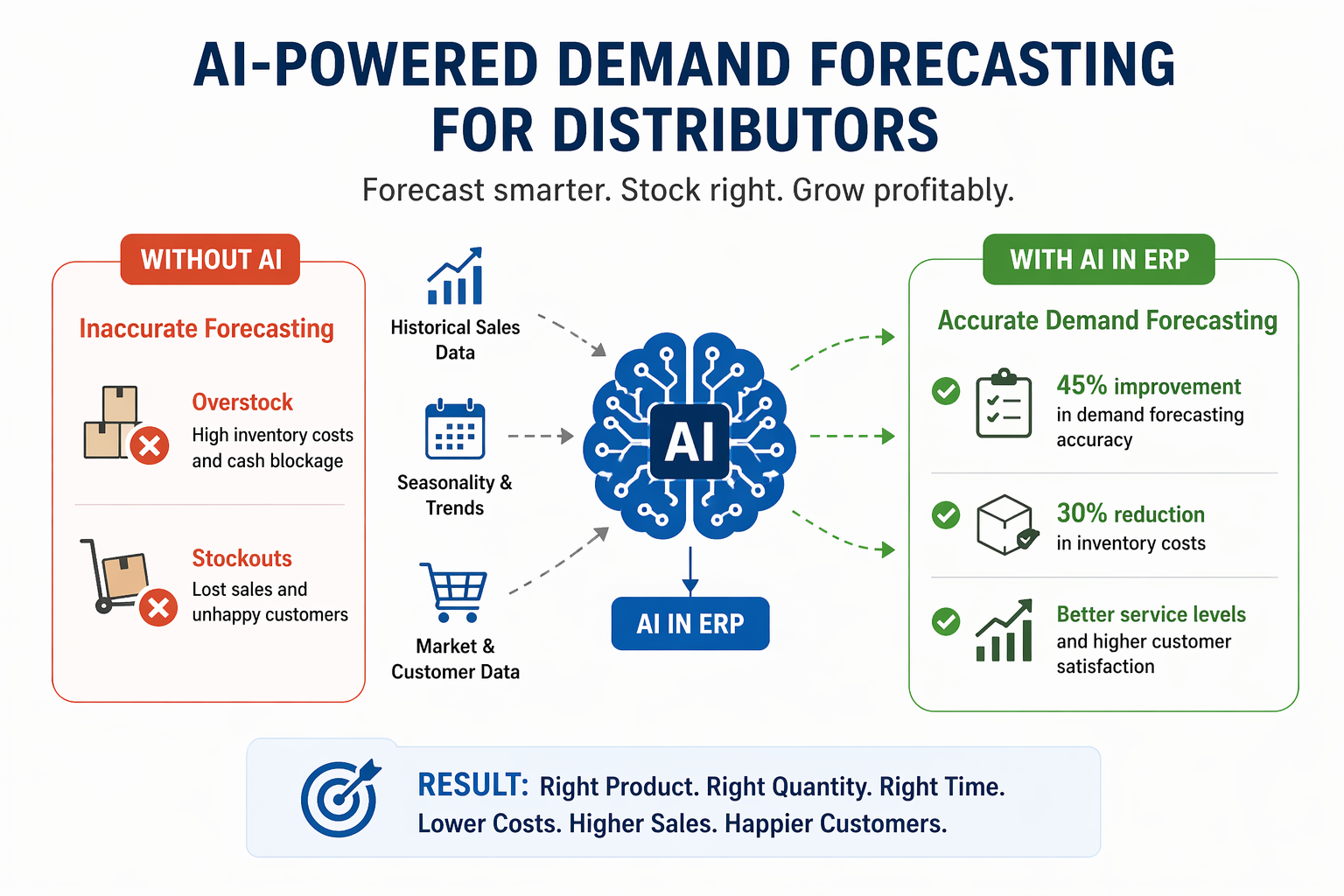
1. Improved Demand Forecasting
- Demand forecasting accuracy improves by 45%
- Inventory costs reduce by 30%
2. Supply Chain Optimization
- Stockouts reduced by 20–25%
- Warehouse efficiency improved by 40%
- Delivery performance improved by 25%
- Logistics costs reduced by 15–20%
3. Real-Time Decision Making
- Edge computing reduces data latency by 75%
- Cloud storage costs reduced by 40%
- Data is processed “milliseconds after it is generated”
4. Process Automation Gains
- Efficiency improvements range from 15% to 65%
- 54% of businesses report successful adoption
5. Financial Accuracy and Compliance
- Financial data processed four times faster
- Fraud detection reduces false positives by 60%
- Compliance costs reduced by 35%
Memorable Quotes from the Research Paper
“AI has made it possible for ERP systems to progress from passive data management tools to proactive business intelligence platforms.”
“The most sophisticated use of AI in ERP systems is cognitive computing, which analyzes enormous volumes of both structured and unstructured data to enable complicated decision-making.”
Visual Takeaway
DCKAP Insights
Integration Is a Major Barrier
The paper also surfaces a structural truth – 42% of firms report considerable integration issues when adopting AI. This gap between AI’s potential and its real-world delivery lives squarely in the integration layer.
For manufacturers and distributors: the path to intelligent ERP isn’t about selecting the most advanced AI module. It begins with solving the cross-platform coordination, data synchronization, and API management challenges the paper identifies as the leading barriers to AI-ERP success.
The research also shows that AI-Enabled ERP (2020s) delivers 45% operational efficiency – compared to just 35% from Cloud ERP (2010s). That 10-point jump is where integration investment pays off.
With the enterprise AI market projected to reach USD 155.2 billion by 2030 and industry-specific AI growing at a CAGR of 38.4%, the window to build an integration-ready ERP foundation is now.
Read This Research Paper If
- You are evaluating AI integrated ERP
- You want to understand the ROI of AI-driven features.
- You want to understand AI’s real impact on operations
- You are exploring predictive analytics or automation
- You are dealing with supply chain or data challenges
Who Should Read It
- Manufacturers
- Distributors
- Supply chain professionals
- CIOs / CTOs
- ERP consultants
- Business transformation leaders
Access the Resource
About the Author
Poornachandar Pokala, Tachyon Technologies, USA

About the Curator:
Tamizh Selvan Dinakaran has over 25 years of experience helping businesses grow through digital marketing, particularly in the distribution and manufacturing sectors. He currently leads customer education at DCKAP, where he creates programs designed to help customers succeed in deriving value from DCKAP’s products. Previously, as DCKAP’s Director of Marketing, he focused on increasing brand awareness and generating leads through effective content marketing. Tamizh specializes in B2B content marketing, marketing operations, and customer success.
Read More Book Reviews

ERP Integration made simple for Manufacturers & Distributors.
Transform your commerce journey by creating an integrated experience for employees and customers.