Going Circular: The Evolution of Reverse Logistics into a Competitive Weapon
[ Author: Rich Bulger ]
Apr 13, 2026
No time to read the Must-Read: Listen to the one-minute summary.
Going Circular: The Evolution of Reverse Logistics into a Competitive Weapon reframes reverse logistics as a competitive weapon in the age of the circular economy. Rich Bulger moves beyond theory to show how companies can transform returns into sales engines, sustainability drivers, and new revenue streams.
Quick Summary
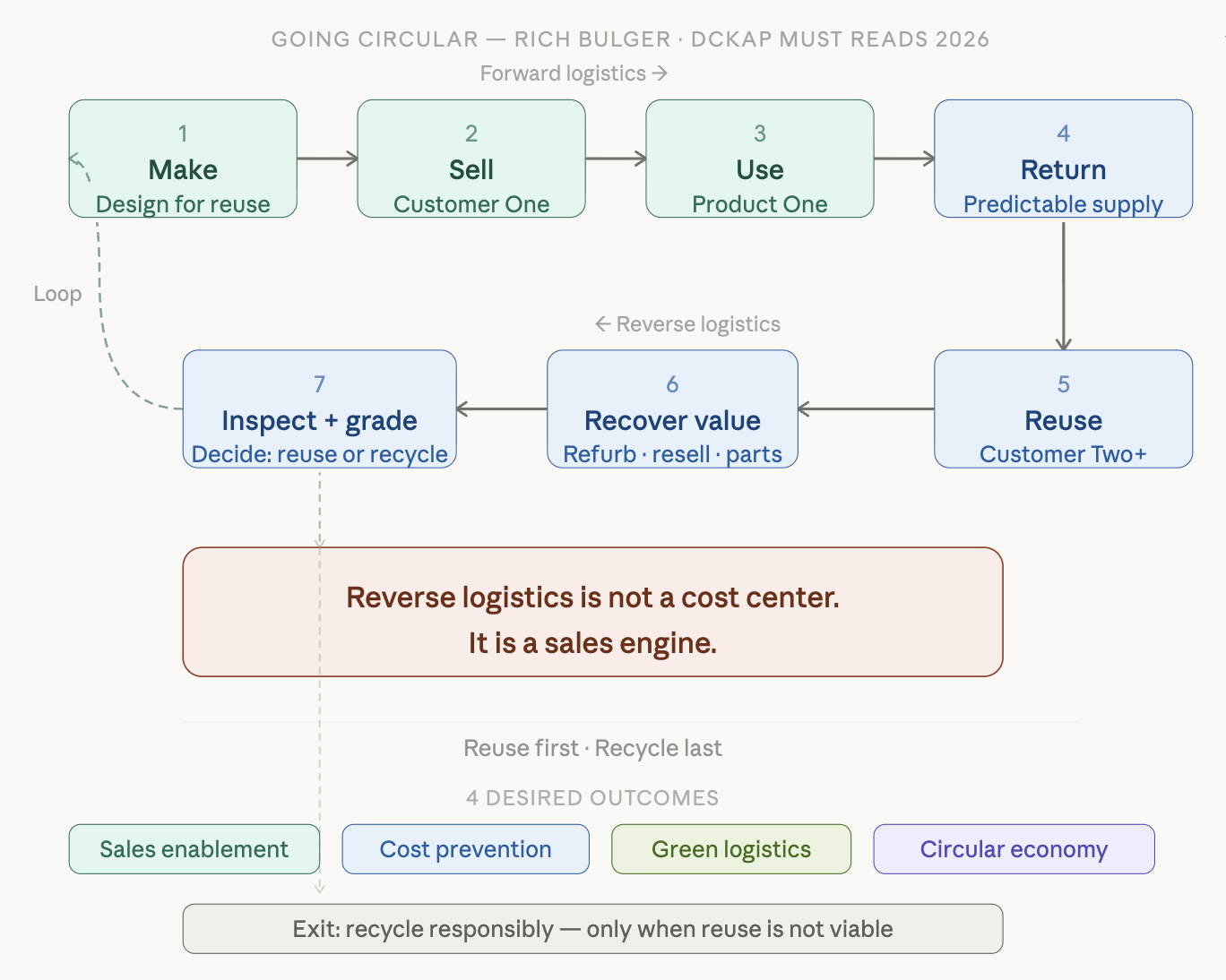
The book explains how warehouse operations and automation can evolve from simply reducing returns to actively enabling resale, refurbishment, and recirculation. Reverse logistics is positioned as a structured system-built on asset recovery, operations, and value generation-that balances four outcomes: sales enablement, cost prevention, green logistics, and circular economy.
Key Takeaways
- Reverse logistics is not a cost center; it is part of the sales engine.
- “Reuse first, recycle last” is the foundation of a mature circular economy.
- Returns can be managed as opportunities for revenue and sustainability, not just risks.
- The four desired outcomes-sales enablement, cost prevention, green logistics, circular economy-must be balanced deliberately.
- Asset recovery, reverse operations, and value generation form the three execution fundamentals.
- Data-driven systems (ERP, WMS, CRM) are critical for efficiency, visibility, and scalability.
- Customer segments (Customer One vs. Customer Two+) shape return flows and resale strategies.
Memorable Quotes from the Book
“Reverse logistics is not a cost center but a part of the sales engine.”
“Reuse first and recycle last are the foundations of a mature circular economy.”
Practical Takeaways for Manufacturers & Distributors
- Reverse Logistics: Treat returns as structured supply streams; design repair/refurb pathways into product planning.
- Efficiency: Standardize RMA (Return Material Authorization) processes, reduce touchpoints, and use centralized returns centers.
- Scalability: Build systems that handle both expected and discrepant returns across omnichannel sales.
- Technology Adoption: Integrate ERP, WMS, and CRM for visibility; deploy AI-powered disposition engines for faster routing.
- Financial Discipline: Blended Benefit (BB = Inventory Value × Velocity) must become a standard metric. If the cost to reuse (CR) exceeds the blended benefit, recycle. If not, the math favors reuse – and the faster that cycle turns, the more value compounds.
A Day-in-the-Life of Reverse Logistics
A warehouse receives a shipment of returned devices. Each unit is scanned into the system, inspected, and graded. High-quality items are refurbished and routed into resale channels; mid-grade units are harvested for parts; low-grade items are recycled. Data flows back into ERP and CRM systems, updating inventory (“reventory”), triggering resale listings, and feeding analytics to improve product design. The process transforms returns into revenue while reducing waste.
Visual Takeaway
DCKAP Insights
The book highlights the need for tight integration between commerce, operations, and reverse logistics. For manufacturers and distributors, this translates into connecting eCommerce platforms, ERP systems, and warehouse operations to enable seamless return processing and resale workflows.
Reverse logistics requires system-level orchestration-capturing return data, automating decision rules, and aligning inventory across channels. Without integration, costs remain hidden and value recovery is inconsistent.
Why This Book Matters Now
With omnichannel commerce and growing sustainability mandates, reverse logistics is no longer optional. Going Circular shows how companies can compete not only on the initial sale but also on the return, resale, and reuse of the same product.
In today’s context, this means protecting margins, meeting ESG goals, and unlocking secondary markets-all through structured reverse logistics.
Who Should Read It
- Manufacturers designing for repair and reuse.
- Distributors managing reventory alongside inventory.
- Supply chain leaders balancing sales, cost, and sustainability outcomes.
- Operations decision-makers seeking scalable, data-driven reverse logistics frameworks.

About the Author
Rich Bulger is CEO of RecirQ Global, a sustainability-focused company. A U.S. Army veteran, he spent 17 years at Verizon, where he launched the first store trade-in program, scaling it to $1.6B annually. He later managed global reverse logistics at Cisco, earning Gartner’s Top Supply Chain award. Bulger serves on the advisory board of the Reverse Logistics Association and holds a master’s degree in Reverse Logistics Management.

About the Curator:
Tamizh Selvan Dinakaran has over 25 years of experience helping businesses grow through digital marketing, particularly in the distribution and manufacturing sectors. He currently leads customer education at DCKAP, where he creates programs designed to help customers succeed in deriving value from DCKAP’s products. Previously, as DCKAP’s Director of Marketing, he focused on increasing brand awareness and generating leads through effective content marketing. Tamizh specializes in B2B content marketing, marketing operations, and customer success.
Read More Book Reviews
ERP Integration made simple for Manufacturers & Distributors.
Transform your commerce journey by creating an integrated experience for employees and customers.