The Warehouse Revolution: Automate or Terminate
[ Author: Peter (Pete) Devenyi, Dr. Miguel Pinilla, and Jim Stollberg ]
Apr 6, 2026
No time to read the Must-Read: Listen to the one-minute summary.
The Warehouse Revolution – Automate or Terminate by Peter Devenyi, Dr. Miguel Pinilla, and Jim Stollberg is a practitioner-led guide to the rapidly evolving world of warehouse automation. The book explains how warehouse operations have evolved from manual, bulk-handling systems into highly automated, software-driven environments. It focuses on how automation, software, and process design come together to meet modern fulfillment demands.
Quick Summary
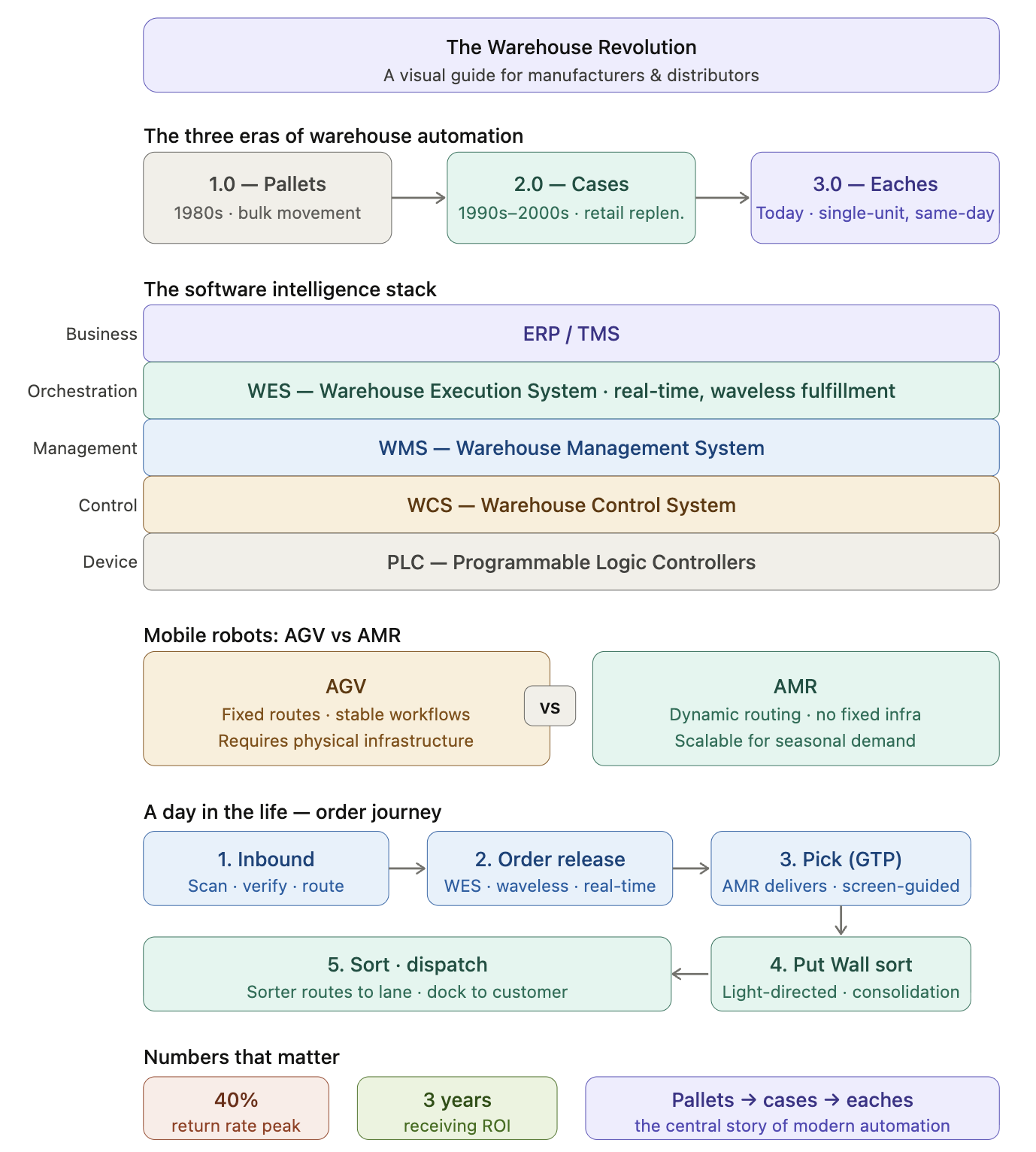
The book maps automation across four eras: Warehouse Automation 1.0 (pallets, 1980s), 2.0 (cases, 1990s–2000s), and 3.0 (individual items, driven by e-commerce) and micro-fulfillment with AI (4.0).
Its central insight is the “eaches problem” – when e-commerce required shipping a single bottle of shampoo to a consumer’s doorstep by 4 pm, the entire modern automation wave was built to solve that challenge at scale. The book covers every stage, from inbound receiving to returns, and the software intelligence that ties it together.
Key Takeaways
- Warehouse automation has progressed through four phases: pallets (1.0), cases (2.0), eaches (3.0), and micro-fulfillment with AI (4.0).
- The “eaches problem”-fulfilling single-item e-commerce orders-drove modern robotics and software innovation.
- Inbound processes (receiving, inspection, put-away) are critical for accuracy; outbound processes (picking, packing, shipping) drive speed.
- Forward pick storage acts like “cache memory,” enabling faster access to high-demand items.
- Software systems (ERP, WMS, WCS/WES, TMS) form the “logistics stack,” coordinating automation hardware and processes.
- Bottlenecks in docks, picking, or packing determine overall warehouse performance.
- Automation is not all-or-nothing: warehouses can selectively automate processes based on cost, throughput, and accuracy needs.
Memorable Quote from the Book
“Efficiency of the warehouse process has become a primary competitive advantage.”
Practical Takeaways for Manufacturers & Distributors
- Optimize inbound accuracy: Strong receiving and inspection prevent downstream errors.
- Adopt selective automation: Focus on high-volume or error-prone processes first.
- Leverage forward pick storage: Position fast-moving items for quick retrieval to reduce labor costs.
- Use software as the warehouse brain: Integrate WMS/WES for real-time visibility and control.
- Plan for scalability: Design systems that can handle pallets, cases, and eaches simultaneously.
- Balance cost vs. speed: Labor-intensive picking and packing drive costs; automation can offset them.
Day-in-the-Life of Warehouse Automation
The day begins with the Yard Management System (YMS) assigning trucks to dock doors. Goods are unloaded, scanned, and recorded in the Warehouse Management System (WMS), which directs them to storage or cross-docking.
As orders flow in from the Enterprise Resource System (ERP) / Order Management System (OMS), the Warehouse Execution System (WES) orchestrates operations in real time. The Warehouse Control Systems (WCS) controls automation (ASRS, conveyors), bringing items to pick stations (GTP), while AMRs handle transport and replenishment.
Items are consolidated via put walls or sorters, then packed and labeled using SLAM (Scan-Label-Apply-Manifest) systems. Sortation routes parcels to shipping lanes, and the Transportation Management System (TMS) plans final dispatch.
Together, YMS, WMS, WES, WCS, ERP/OMS, and TMS create a synchronized, real-time warehouse operation.
Visual Takeaway
DCKAP Insights
For manufacturers and distributors, the “Warehouse Revolution” is a mandate for digital transformation. The book clarifies that hardware is only as effective as the system integration behind it; a disconnected ERP cannot support the real-time demands of a WES.
By aligning commerce and operations, businesses can ensure that the “eaches” promised on a digital storefront are accurately tracked through the “logistics stack”.
This integration enables the visibility required to manage a networked, multi-warehouse fulfillment strategy.
Why This Book Matters Now
- E-commerce growth has shifted demand toward small, frequent, and fast deliveries.
- Labor shortages are driving adoption of automation and robotics.
- Demand variability requires flexible systems capable of real-time adaptation.
- Customer expectations for speed and accuracy have increased operational complexity.
The book highlights that traditional batch-based systems cannot meet these demands-modern warehouses must operate continuously, adaptively, and as part of a broader fulfillment network.
Who Should Read It
- Supply chain and operations leaders
- Warehouse and distribution managers
- Manufacturing logistics heads
- E-commerce fulfillment leaders
- Technology and automation decision-makers
- Students of manufacturing and distribution
Especially relevant for organizations dealing with high SKU counts, multi-channel fulfillment, or scaling operations.
Here are concise author bios for the About the Authors section of your book brief for The Warehouse Revolution.

About Authors
Peter (Pete) Devenyi: 40-year engineering veteran, former leader at BlackBerry and Dematic, teaches engineering leadership at the University of Toronto.

Dr. Miguel Pinilla: Stanford PhD, Fulbright Scholar, 30+ years in supply chain systems, CTO at Arda, founder of Salduba Technologies.

Jim Stollberg: 35+ years in warehouse automation and consulting, former executive at Dematic, HK Systems, and Accenture, Executive in Residence at Marquette University.

About the Curator:
Tamizh Selvan Dinakaran has over 25 years of experience helping businesses grow through digital marketing, particularly in the distribution and manufacturing sectors. He currently leads customer education at DCKAP, where he creates programs designed to help customers succeed in deriving value from DCKAP’s products. Previously, as DCKAP’s Director of Marketing, he focused on increasing brand awareness and generating leads through effective content marketing. Tamizh specializes in B2B content marketing, marketing operations, and customer success.
Read More Book Reviews


ERP Integration made simple for Manufacturers & Distributors.
Transform your commerce journey by creating an integrated experience for employees and customers.