No time to read the Must-Read: Listen to the one-minute summary.
Distributors are built on a familiar logic: relationships, negotiation, and incremental growth. But ‘When Machines Become Customers: Ready or not, AI enabled non-human customers are coming to your business. How you adapt will make or break your future’ – book reveals a fundamental disruption-customers are no longer just humans.
Machines are beginning to:
- Make purchasing decisions
- Optimize buying behavior
- Eliminate inefficiencies
For distributors, this is not a distant trend. It directly challenges:
- How you sell
- How customers choose you
- How long customers stay
Quick Summary
This book reframes the future of commerce: machines, not just humans, will become active customers.
By 2030, CEOs expect 15–20% of revenue to come from machine customers, influencing trillions in purchases. For distributors and manufacturers, this is not a distant theory-it’s a certainty.
The authors argue that success will depend on structured product data, API connectivity, and a shift from emotional marketing to logic-driven transactions.
When Machines Become Customers forces a harder question: what happens when your customer isn’t a person at all? This isn’t a technology book. It’s a business model reckoning – one grounded in a decade of Gartner research.
Your next best customer won’t have a name – but it will have an API, and it will choose your competitor if your data isn’t ready.
Key Takeaways
Custobots (Machine Customers) Beat Humans at Buying
- Machines process exhaustive data, forget nothing, run 24/7, and lock into reliable suppliers without emotion.
- For distributors, transactional reorders (MRO, safety gloves) shift to zero-touch via smart shelves or ERP triggers-no more stockouts from human delay.
So what: Identify the everyday objects your customers rely on—tanks, bins, shelves-and enable them to trigger automatic reorders the moment stock runs low. This way, you capture sales that humans often miss due to delays or forgetfulness.
Three Phases of Machine Customers
- Bound (today): Rule-based, tied to suppliers (e.g., HP Instant Ink).
- Adaptable (mid-term): Goal-driven, with discretion and autonomy (e.g., robo-trading).
- Autonomous (long-term): Fully independent, completing transactions end-to-end. (In Future-Waymo Taxis)
Data Trumps Brand in Machine Markets
- Machines evaluate specs, lead times, substitutes-not logos or golf outings-comparing 50 factors relentlessly.
- Manufacturers lose if tensile strength or compliance data is incomplete; distributors get bypassed without real-time APIs.
So what: Standardize PIM data with UNSPSC codes; expose it via open platforms to win feature battles.
Branding Splits Into Two Layers
- Logic Layer: Machines care about specs, APIs, uptime, and certifications.
- Psychology Layer: Humans still decide which vendors to trust before delegating.
SEO Evolves Beyond Google
- AEO (Answer Engine Optimization): Optimizing for AI assistants.
- PEO (Product Experience Optimization): Machine-readable product catalogs.
- Human SEO: Still matters for vendor trust before automation begins.
API Connectivity Is Survival
- Without APIs, distributors are invisible to AI buyers. Connectivity is the entry ticket.
Pricing Speed Is Non-Negotiable
- Human-mediated pricing (“we’ll get back to you”) makes you irrelevant. Machines demand instant, machine-readable pricing.
Platforms Lock In Winners Fast
- Only API-connected players compete.
- Without cloud integration, distributors become invisible to custobots (machine customers) querying price/stock directly.
So what: Prioritize ERP-to-marketplace sync; early movers dominate non-linear growth.
Three Paths: Choose or Perish
- Path 1: You Don’t Make Machine Customers, But You Want to Sell to or Serve Them
- Path 2: You Can Make Machine Customers That Buy From You
- Path 3: You Can Make Machine Customers That Buy From Others
Memorable Quotes from the Book
- “The only players will be those who have API connections to the cloud-based market.”
- “Adoption is a certainty – the only question is timing.”
- “Machine customer losers won’t even realize they are being played.”
- “Billions of Machine Customers are headed your way. Ready or not. Use them as a force for good.”
Practical Takeaways for Manufacturers & Distributors
For manufacturers and distributors, the implications are immediate:
- Audit product data: Ensure specs, SKUs, and classifications are complete and machine-readable.
- Invest in APIs: Connect pricing, inventory, and catalogs to cloud-based marketplaces.
- Accelerate pricing workflows: Eliminate manual lookups; move to instant, machine-readable pricing.
- Reframe branding: Focus on trust-building at the vendor selection stage.
- Prepare for machine-to-machine marketplaces: Anticipate custobots (machine customers) negotiating with sellerbots.
Day-in-the-Life of Machine Customers
It’s 2:47 AM. A procurement bot managing MRO supplies for a mid-size manufacturer in Ohio detects that hydraulic filter stock has dropped below the replenishment threshold. It queries three distributor APIs simultaneously – checking real-time inventory, price, lead time, and compatibility specs against the equipment’s maintenance record.
Two distributors (Distributor A and Distributor B) respond instantly with structured data. The third – your company – returns a “contact us for pricing” page. The custobot (Machine Customer) doesn’t wait. It doesn’t follow up. It places the order with Distributor B, logs the transaction, and moves on to the next item on its list. By the time your sales rep arrives at 8 AM, the deal is already shipped.
This is not a hypothetical. It is the operating reality the book describes – playing out right now in advanced manufacturing and distribution environments across the US. The machine didn’t choose your competitor because of a better relationship or a lower price. It chose them because their door was open and yours was locked.
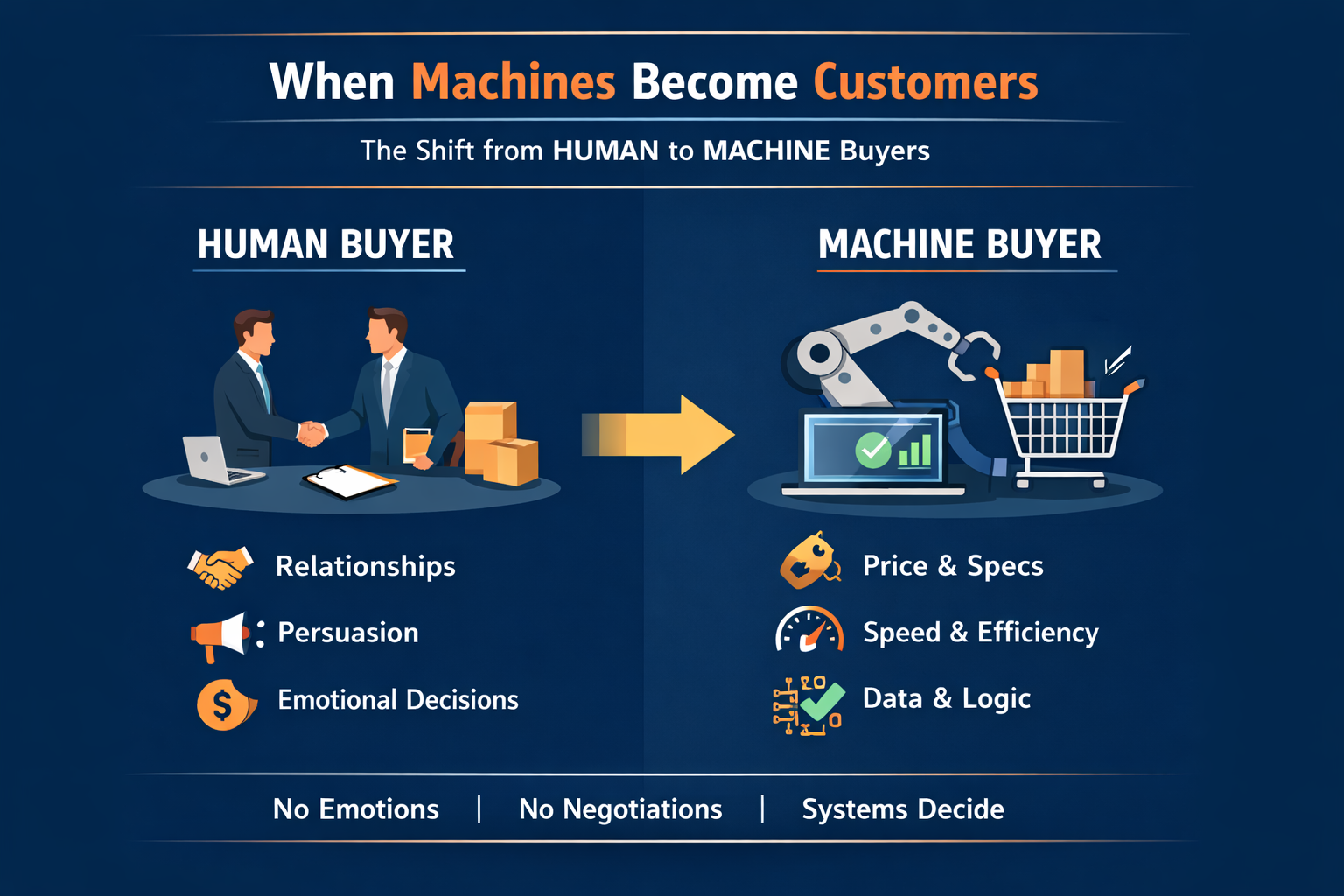
Visual Takeaway
DCKAP Insights
Structured data and APIs aren’t digital upgrades-they’re survival infrastructure. Distributors must clean, standardize, and integrate product data across ERP, EDI, PIM, and various systems now. The book makes it clear: machine customers treat incomplete data and fragmented silos as a hard no. Winners act like this shift is certain, not speculative.
Why This Book Matters Now
Margins are tightening, customer retention is harder, and eCommerce giants are reshaping expectations. This book shows that the next disruption won’t be another marketplace-it will be machines themselves. For distributors, the timing is critical: early movers will dominate, late movers may find the door permanently closed.
Who Should Read It
- CEOs and Sales Heads: To understand how machine customers will reshape revenue streams.
- Digital Leaders: To prepare systems for API-driven transactions.
- Manufacturers and Suppliers: To see how IoT-enabled products can become customers themselves.
This is not optional reading-it’s a survival guide for anyone in distribution.

About Authors
Don Scheibenreif is a Distinguished Vice President Analyst at Gartner, based in California. He leads Gartner’s research on Customer Experience and has spearheaded the firm’s Machine Customers research since 2015. A sought-after international keynote speaker, he has earned multiple thought leadership awards – including recognition at Gartner’s IT Symposium. Before joining Gartner in 2010, Don spent 22 years as a senior marketing leader across the CPG, Retail, and B2B distribution sectors.

Mark Raskino is a Distinguished Vice President Analyst and Gartner Fellow (retired), based in London, UK. He leads Gartner’s CEO research and focuses on technology innovation and business growth strategy. During his 22 years at Gartner, he has co-authored two books on The Hype Cycle and Digital Business, and previously served as a senior researcher in e-business and digital business trends. Prior to Gartner, he spent 15 years in business IT across the airline, Telecoms, and Oil industries.
Together, they bring decades of combined experience at the intersection of technology, business leadership, and customer strategy – making them uniquely positioned to explore the emerging era of machine customers.

About the Curator:
Tamizh Selvan Dinakaran has over 25 years of experience helping businesses grow through digital marketing, particularly in the distribution and manufacturing sectors. He currently leads customer education at DCKAP, where he creates programs designed to help customers succeed in deriving value from DCKAP’s products. Previously, as DCKAP’s Director of Marketing, he focused on increasing brand awareness and generating leads through effective content marketing. Tamizh specializes in B2B content marketing, marketing operations, and customer success.
Read More Book Reviews
ERP Integration made simple for Manufacturers & Distributors.
Transform your commerce journey by creating an integrated experience for employees and customers.