Here’s the reality of businesses today: they’re running a mix of ERP, maybe something legacy, Salesforce, and several SaaS tools acquired over the years. Getting seamless integration across all of that isn’t a nice-to-have; it’s a prerequisite for making order processing work at all.
Choosing the right order-to-cash automation software isn’t about the most attractive feature set.
It’s about finding the platform that’s right for how your business really works. This means considering how the platform performs across different industries, ERP environments, and order volumes.
How We Made This Shortlist
We assessed each platform against a common set of criteria covering the entire O2C journey from initial order capture to final payment reconciliation:
- ERP and EDI integration depth: A platform’s value is only as good as its ability to connect to your legacy systems. We looked at the number of ERP connectors per vendor that are supported, their strategy for EDI document exchange, and the extent of custom development required for non-standard environments.
- Automation capabilities: We focused on whether the AI tooling really helps reduce delays and manual intervention, not just as a marketing term. That’s error detection, intelligent document processing, and workflow automation that non-technical staff can handle.
- Ease of implementation and maintenance: The real constraint is to have a successful implementation. We also took into account implementation complexity, time to value, and the ability for business users to manage the platform day-to-day without a dedicated developer.
There are other platforms available besides the five listed below. For businesses that are running real cash operations, from mid-market distributors to large enterprises with complex application landscapes, they are the ones that consistently stood out across these criteria.
Top Tools: Overview
| Solution | Best For | Key O2C Strength | ERP / EDI Integration |
| DCKAP | Distributors & manufacturers | ERP-first order entry automation; EDI, OCR, API | Deep connectors: P21, Eclipse, SAP, NetSuite, Dynamics, Infor, Sage |
| Celigo | Mid-market to enterprise O2C | Pre-built Integration Apps; AI error management (Ora) | Strong for popular ERP-eCommerce stacks (NetSuite, Shopify, etc.) |
| Cleo Integration Cloud | B2B / supply chain O2C orchestration | End-to-end O2C orchestration; AI error resolution (96%) | EDI (X12), API, MFT; D365, NetSuite, SAP, Oracle |
| Jitterbit | Enterprise AI + EDI integration | AI Assistant + EDI; low-code app dev | Pre-built connectors, EDI, API management |
| Boomi | Complex enterprise application stacks | Broadest connector library; API + data management | Widest ERP/SaaS/legacy connector coverage |
1. DCKAP
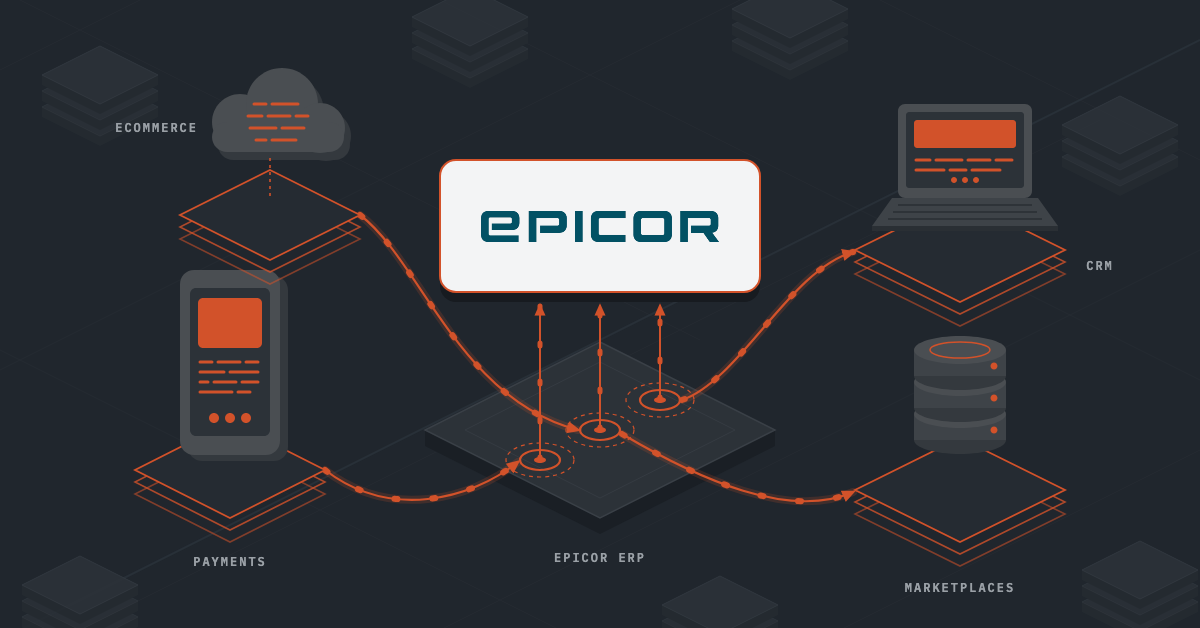
Its two core products, DCKAP Integrator and DCKAP EDI, connect ERP systems to eCommerce platforms, CRM, EDI partners, and marketplaces. The whole point is to automate order management across every channel into a single system.
Key Features
- ERP connectivity: Works with Epicor Prophet 21, Eclipse, SAP, NetSuite, Dynamics 365, Infor, Sage, Distribution One, and more.
- API-based order automation: Customer orders from Shopify, Magento, and BigCommerce flow straight into the ERP in real time.
- EDI integration: Handles structured purchase orders (850 PO documents) via VAN or AS2, cutting manual work on trading partner order entry.
- Intelligent document processing: OCR pulls order data from emailed PDFs directly into the ERP. No electronic orders required from the customer.
- Real-time bi-directional sync: Orders, inventory, pricing, and customer data stay in sync across all connected systems.
How It Supports the O2C Process
The re-keying problem is where most distributors lose time they can’t afford. An order comes in via email, EDI, or web store, and someone has to manually enter it into the ERP. DCKAP removes that step entirely. Orders go in the moment they’re placed. Order fulfillment moves faster. Finance teams actually see what’s happening in real time instead of working from yesterday’s data.
One Gartner Peer Insights reviewer (Director of IT, Manufacturing) said it plainly: “The DCKAP Integrator is something you set up and forget. We haven’t had outages or any issues in 3+ years.” For high-volume distributors, that kind of order processing reliability has a direct effect on cash flow and customer experience.
Pricing
Custom pricing based on your number of systems, trading partners, workflows, and other integration requirements.
Pros
- Deep distributor ERP connectors (P21, Eclipse, Kinetic, TrulinX).
- Handles API, EDI, OCR, and RPA.
- Non-technical staff manage day-to-day without involving a developer.
Cons
- It’s an order entry and integration platform, not a full AR tool.
- There’s no native credit management, cash application, or dispute resolution built in.
Best for:
Mid-market distributors and manufacturers
2. Celigo
Celigo has been a Gartner Magic Quadrant Visionary for iPaaS for multiple years. For O2C work, the main draw is its library of pre-built Integration Apps, ready-to-use connectors that sync order-to-cash, inventory, customer data, and financials between ERP and eCommerce without needing custom mapping built from scratch.
Key Features
- Pre-built Integration Apps: Bidirectional sync for order management, inventory, customer records, and financial data; no custom mapping needed.
- AI-powered error management: Celigo Ora (launched May 2026) uses artificial intelligence to catch, diagnose, and fix integration failures before they reach fulfillment or billing.
- Low-code Flow Builder: Business users can build and update connectors without writing code.
- ERP-eCommerce templates: GraphQL-based for popular stacks like Shopify–NetSuite.
- O2C workflow coverage: Ties ERP, billing, and CRM together for accurate quoting, order processing, and timely invoicing.
How does it help the O2C process
If you’re on a common ERP-eCommerce stack, Celigo’s pre-built apps can cut your go-live timeline significantly. Instead of building integrations from scratch, you’re configuring something that already exists. That means fewer errors, fewer gaps in the path to cash collection, and a faster time to value.
For teams thinking seriously about where AI tools fit into their automation strategy, that’s worth paying attention to.
Pricing
Custom pricing, based on the number of integration flows and volume.
Pros:
- AI error detection that catches problems before they cascade.
- It is accessible enough for non-technical users to maintain.
- Consistent, meaningful updates.
Cons
- Custom or niche ERP environments need more development work.
- Pricing scales sharply at higher transaction volumes worth checking carefully before you commit.
Best for:
Mid-market to enterprise companies looking for pre-built O2C integration apps
3. Cleo Integration Cloud (CIC)
Most integration platforms move data. Cleo actually runs the process. It positions itself specifically as an O2C execution-layer orchestrator, meaning it’s not just connecting systems; it’s actively monitoring and managing the entire O2C cycle from order capture to final payment.
Key Features
- End-to-end O2C orchestration: Aligns ERP, TMS, and WMS to track physical execution and financial invoicing from order through payment reconciliation.
- AI-native Intelligent Error Resolution: Resolves 96% of transaction anomalies without manual intervention.
- InvoicePay: Embedded invoice financing that speeds up cash collection, with no waiting on 30/60/90-day payment terms.
- Supply Chain Orchestration Console: Single dashboard for real-time O2C performance, KPIs, and Supply Chain Management metrics.
How It Supports the O2C Process
InvoicePay is probably the most differentiated feature. Waiting 30, 60, or 90 days for payment is one of the most persistent cash flow problems in B2B, and InvoicePay directly addresses it by making cash accessible earlier.
For businesses where healthy cash flow is tight because of payment terms, not because of poor revenue, this feature is worth a serious look. Fair warning, though: it’s a sophisticated platform and implementation isn’t light.
Pricing
Custom Quote-Based Pricing. Get enterprise quotes for Cleo.
Pros
- Built specifically for end-to-end O2C.
- InvoicePay accelerates cash flow without changing payment terms.
- 96% auto-resolution on errors.
- Unified real-time visibility across the supply chain.
Cons
- Overkill for simple ERP-eCommerce setups.
- Implementation is complex.
- Pricing isn’t public, so you’re negotiating blind.
Best for:
Companies that want robust EDI and supply chain capabilities, with end-to-end O2C orchestration.
4. Jitterbit
Jitterbit Harmony is a broad platform for integration, API management, EDI, and low-code app development in one place. For order management and O2C, it connects eCommerce, ERP, WMS, and billing systems. The 2026 releases added AI tooling throughout, most notably the AskJB AI Assistant.
Key Features
- O2C workflow automation: Connects eCommerce, shipping, finance, WMS, and ERP to automate order processing, fulfillment, and billing.
- EDI Integration: Native EDI handles B2B document exchange, purchase orders, invoices, and shipping notices with trading partners.
- AskJB AI Assistant: Natural language interface for building integration pipelines. Reduces developer involvement for routine workflow changes.
- Low-code app development: Build lightweight apps on integrated data management layers without a separate development platform.
How It Supports the O2C Process
The AskJB assistant is what makes this platform actually usable for non-technical teams. Now, business users can handle workflow changes that previously required a developer and a ticket queue.
Pricing
Custom pricing. Free trial available.
Pros
- Wide coverage in one product.
- Strong EDI.
- An AI assistant makes it easier for non-technical users.
- Works for SMBs and enterprises alike.
Cons
- Broad scope, shallower depth in specific areas.
- Pricing not listed publicly.
Best for:
Enterprises that need AI-powered integration with EDI and low-code app development
5. Boomi
When the application landscape is genuinely complicated, most enterprise IT teams turn to Boomi. It’s been doing these tasks for a long time: integration, API management, and data management across SaaS, ERP, cloud, and legacy systems. O2C automation is a documented core use case, and the connector library is what sets it apart.
Key Features
- Extensive connector library: Among the largest in enterprise iPaaS, SaaS, databases, ERP systems, cloud, and legacy systems.
- API management: Full lifecycle management for teams building and consuming APIs.
- Data management: Master data management and embedded data quality are critical for clean financial performance reporting.
- Low-Code Integration Builder: Drag-and-drop interface for building integration flows without coding.
How it Benefits the O2C Process
Boomi’s connector breadth is what makes this integration possible. Customers have documented 2x growth in sales team order volume post-O2C automation, and the platform’s inventory management and Predictive analytics capabilities extend the value well beyond the core cash cycle.
Pricing
Pay-as-you-go starts at $99/month plus $0.05 per Boomi Message. The professional tier is around $550/month for up to 5 connections. Enterprise contracts typically run $50,000–$190,000+/year, and that’s before implementation and support, which often add another 2–3x.
Pros
- Broadest connector library available.
- Unified integration, API, and data management in one platform.
- Transparent entry-level pricing for smaller use cases.
Cons
- Enterprise pricing is a serious commitment.
- Total cost of ownership tends to run much higher than the license fee.
- Not built for wholesale distribution specifically.
Best for:
Enterprises with diverse, complex application landscapes needing wide connector coverage
How to Select the Right Order-to-Cash Vendor
First, map where your O2C process actually breaks down. Is it order entry? Getting orders into the ERP without manual re-entry? Delays in invoicing and cash application? Are open invoices unpaid, and is Days Sales Outstanding increasing?
Different platforms fix different parts of the cycle. Buying the wrong platform is an expensive mistake.
Key areas to evaluate
- ERP and EDI integration: Ensure the platform has a dedicated, prebuilt connector to your ERP, as well as support for the EDI transaction sets your trading partners and suppliers require. Custom development is long and costly.
- Credit checks and dispute resolution: Know whether credit management, native credit checks, and structured dispute resolution workflows are native or fully delegated to your ERP.
- Cash application automation: Inquire about the process of matching incoming payments to open invoices. Better decision-making here reduces reconciliation time and increases visibility into financial performance.
- Implementation and ownership: Get a realistic timeline, and clarify what your team owns post go-live. Platforms that require dedicated developers to manage day-to-day cash operations tend to go over budget.
Conclusion
There’s no universal answer here. What matters is the fit. Distributors and manufacturers with high order volumes should look at DCKAP first; it’s built for exactly that problem, and it removes the manual work that slows order processing and delays cash collection.
Celigo and Boomi fit better when connector breadth is the real challenge. Boomi goes deeper on complex enterprise stacks; Celigo gets you live faster on common ERP-eCommerce combos.
Cleo is the one to evaluate whether your cash flow problem is tied to payment terms. And Jitterbit makes sense when you want EDI, AI, integration, and low-code app development from one vendor instead of three or four. It’s not the deepest in any area, but the breadth is real.
Interested in one for your business? Schedule a chat with our integration experts.