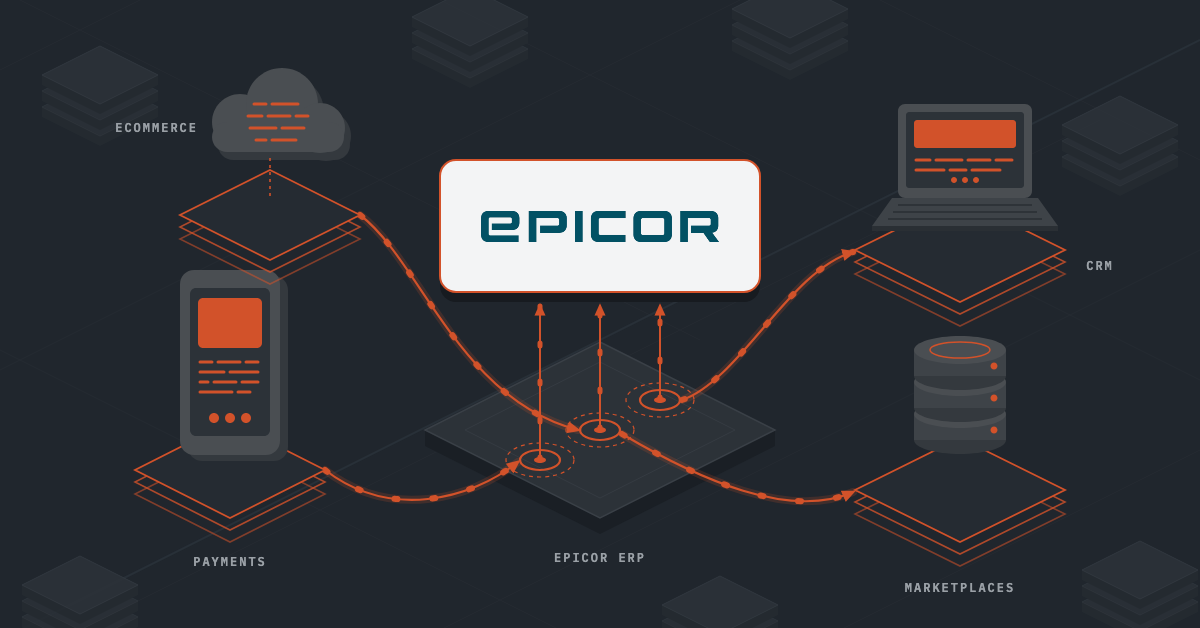
Two integration decisions repeat regardless of which Epicor a distributor runs. The ERP stays the source of truth and setting up your middleware well outlasts endpoints.
The cost of skipping it is documented elsewhere. Gartner puts poor data quality at “at least $12.9 million a year on average,” based on 2020 research, and McKinsey’s 2026 B2B Pulse of nearly 4,000 decision-makers found the leading reason B2B buyers switch suppliers is now inconsistent information across teams.
Leading distributors are investing in flexible, scalable, and customized integration design that’s built to match how they operate. Here are some examples of businesses using DCKAP to achieve that with their Epicor ERP.
Epicor Prophet 21 Case Studies
Most of our Epicor work sits here, in six key patterns.
Storefront syncs, and where they stop being simple
The baseline is familiar: products and inventory down from the ERP, and orders and customers up. The Chas. E. Phipps Company, a concrete accessories distributor trading since 1921, runs seven pipelines between P21 and BigCommerce. The interesting ones aren’t the order syncs: it’s inventory, where kit items must be pulled from a different P21 table than normal items, and a dedicated Ship-To pipeline that lets staff maintain addresses in the ERP without touching the storefront.
Steel and Pipes, an industrial steel supplier serving Puerto Rico and the Caribbean since 1979, needed four pipelines between P21 and Shopify; the challenging part was getting product hierarchy out of P21 and into Shopify’s category structure. That build took around two weeks. Marysville Marine layered its P21 integration onto a Magento 2 Commerce Cloud replatform, with PCI compliance a critical constraint.
Howard Supply, an oilfield and mining supplier stocking over 90,000 items across 20-plus locations, shows where B2B departs from the template: ten modules went in, half with no B2C equivalent: credit line offers, request for quote, sales rep creation, multi-warehouse inventory, and store pickup.
Moody Price added segmented dynamic pricing, an accept-or-reject quote workflow, and tax-exemption document uploads; Quality Farm Supply is the outlier, a B2C Shopify store with a PIM feeding product content alongside the P21 pipeline.
When the order isn’t simple
JSI Cabinetry makes premium wood cabinetry to order, so every online configuration has to become a complete product structure inside P21 before manufacturing can start. We built that piece as live API calls at cart and checkout rather than a scheduled sync. When a shopper adds a single item or a multi-component custom kit, the integration checks P21 and creates the product if it doesn’t exist, pulls inventory back, verifies credit status before the order is allowed, calculates available ship dates, and validates PO number uniqueness at placement.
Cancellations sync both ways; Magento returns create the RMA in P21, and a batch layer handles freight programs and offline orders underneath.
CRM, where the ERP stays the source of truth
The Lab Depot, a laboratory supplier handling 50 to 80 orders a day, needed three systems talking instead of two. Thirteen pipelines chain Magento to P21 to HubSpot, each designated as batch or dynamic, including live “Recent Purchase” and “Buying History” calls that surface account-level order history in the storefront.
Payments
Not every integration touches a storefront. At North South Supply, a family-owned irrigation and drainage distributor, “we had to manually capture Credit Card transactions on the card processor site and then enter that authorization data manually into Prophet 21,” said John Suit, Director of Information Systems.
The integration now picks up the transaction ID from P21, captures the payment on the processor site, retrieves the authorization code, and writes it back. Suit on the result: “In almost a year, the Integrator has run successfully with no issues and minimal interaction from our IT Department.”
Suppliers, marketplaces, and procurement platforms
Sell-side isn’t the only direction. United Surface Preparation, a Minnesota abrasives specialist, connected P21 to 3M’s database using pre-built 3M connectors; running pricing, inventory, and purchase order processing is done one way in batches. This integration went live in three months and eliminated the need for constant follow-up with 3M for current data.
C. W. Hayden Co. went the other way, putting P21 offers onto the 3M Marketplace through Mirakl, with a custom auto-approval feature that accepts 3M orders and notifies the team.
Quad City Safety, a PPE supplier tracing back to 1967, runs a three-system order lifecycle: TK Elevator purchase orders enter through the Jaggaer procurement platform, flow through EvolutionX into P21, and confirmations, shipment, ASN data, and invoices flow back out to Jaggaer.
Replacing what was already there
A recurring pattern in our P21 work: something was connected before, and it stopped being good enough.
Berk Enterprises had Magento connected to P21 through an out of the box connector, and reported manual work, frequent errors, and slow support resolution. Quest Safety used their legacy platform’s native connector, and the case study records that it didn’t help much.
Affiliated Parts had the opposite problem: migrating from Fishbowl to P21 broke a working link to their Magento store. Operations Manager Mike Carlson afterwards: “I don’t have to worry about whether orders are syncing; it’s all just happening in the background.”
Sometimes the ceiling is the API itself. Zuo Modern had no prior connection to replace; their case study records that requirements “included complex data transfer logic to connect with Epicor Prophet 21 which the native Prophet 21 API was unable to cater to.”
Building Controls & Solutions had Ultra Commerce wired directly to P21 and found every new module turned into a full end-to-end testing project. Director of Ecommerce John Witt describes the fix as decoupling: “Think of DCKAP as a power strip. You can plug in a hair dryer, a toaster—whatever you need. And we can move that strip to the living room or anywhere else. The power grid is our ERP system.”
Spruce Industries, a janitorial supplier operating since 1965, illustrates this scenario in reverse: their pipelines were built against Magento, then switched to Axim Commerce when they changed platforms rather than rebuilt.
If you run Prophet 21, the work usually starts with the standard four: product, inventory, order, and order processing, and then follows wherever your business actually differs: customer-specific pricing, credit and quote logic, a card processor, a supplier feed, a marketplace, and a CRM. Four of the P21 projects above replaced something already in place: a native connector, ECC, or a direct point-to-point link that had stopped scaling.
Epicor Eclipse Case Studies
Plumbing Distributors, Inc. is our clearest Eclipse build, and worth budgeting against: some of the ground it covers—Purchase Order, Accounts Payable, Accounts Receivable, Price Matrix, and Warehouse—sits behind Epicor’s Premium API bundles, not the standard endpoints.
The family-owned Georgia distributor was still building its Shopify Plus storefront, so the team designed and tested the integration against a site that didn’t exist yet. Eight pipelines went live: customer and location sync across 500-plus legacy ship-to locations, contract pricing retrieved in real time as a B2B customer browses or updates a cart, bidirectional orders, shipment updates, Shopify payments posted into Eclipse, and minimum order quantity rules.
Inventory sync for 15,000 records dropped from roughly 1.5 hours to around 5 minutes, and pick tickets were generated almost immediately after purchase.
HVAC Wholesale Direct runs five pipelines between Eclipse and BigCommerce, including real-time customer-specific pricing, with customers and orders flowing from the storefront into the ERP.
Edelman Home took Eclipse into marketplace territory, routing both Shopify and Amazon orders—both Seller Fulfilled and FBA—via the Amazon Selling Partner API into Eclipse, with inventory and pricing flowing back out.
If you run Eclipse, we build against the published REST API where it covers the need and around the Premium bundles where it doesn’t. The recurring asks are contract pricing resolved live at the cart, order, and shipment round-trips, payments posted back into Eclipse, and a second sales channel landing in the same ERP without a second process.
Epicor Prelude Case Studies
LAPP Tannehill distributes wire, cable, and connectivity products from over 200 manufacturers and was entering quotes and orders into Prelude, a line Epicor no longer markets, with no product page or published API to design against entirely by hand.
Six batch pipelines now move customers, orders, and quotes from Magento into Prelude and products, inventory, and order processing back out, refreshed nightly, while four dynamic syncs handle customer pricing, offline orders, and open order detail in real time. The quote pipeline is the unusual piece: quote automation, not just order automation; both had been manual, and both were named as the original complaint.
If you run Prelude, there is no current Epicor product page and no published API reference to design against, so the work is discovery-first and built to the instance rather than to a spec.
What LAPP Tannehill wanted is typical of the line: get quotes and orders out of manual entry, keep product setup in the ERP where it belongs, run the bulk of it nightly, and reserve real-time calls for the few things that genuinely cannot wait.
Epicor BisTrack Case Studies
Building & Plumbing Supplies, an independent family business that has supplied trade professionals for over 90 years, ran BisTrack on-prem behind an EvolutionX storefront. It was common enough for this line that we developed a custom API framework just to let the two platforms talk securely before any pipeline could be built.
Their problem list going in was long: inconsistent product and inventory data, negotiated customer pricing that wouldn’t hold online, disconnected order workflows, no customer visibility into invoices or order history, and manual syncing of financial records.
What went in: batch syncs for customer, product, inventory, sales orders, and order processing; an accounts receivable sync that makes the case study flags unique; and dynamic syncs pulling pricing, order, and invoice history live from BisTrack on demand, including orders staff keyed directly into the ERP rather than the storefront.
If you run BisTrack, the first question is on-prem or cloud, because on-prem means building the secure API layer before any pipeline exists. After that, the asks are consistent across building supply: negotiated pricing that holds online, an AR feed, and customers able to see their invoices and order history.
Where DCKAP Integrator Fits
Every build above runs on the same platform, which is why the same vocabulary keeps surfacing:
- Batch Sync or Dynamic Sync. Pipelines run on a schedule. DCKAP’s published examples include “every 15 minutes, once a day, every Monday,” or firing on a webhook the moment something happens. That’s why The Lab Depot’s thirteen pipelines are each designated one or the other, and why Building & Plumbing Supplies can pull an invoice out of BisTrack on demand while its product data moves on a schedule.
- Drag-and-drop mapping, with Python for custom rules. Ordinary field mapping needs no code; it is logic specific to one business. JSI Cabinetry’s credit check and Moody Price’s segmented pricing run through Python instead.
- A custom API for Prophet 21. DCKAP maintains its own API for P21 rather than depending solely on the native one, which is the gap Zuo Modern’s requirements had run into.
- ERP-first, platform-agnostic architecture. Systems sync through the ERP rather than directly to each other, which is why the Flow Control Group could keep P21 untouched as a system of record and why Spruce Industries changed storefronts without rebuilding.
- Detail loggers and email notifications. Belmont Equipment, running P21 and EvolutionX, put it directly: “We enjoy the custom e-mail alerts that the Integrator team built for us… This feature helps to reduce internal IT costs,” said Nina M., Process Improvement Manager. The alert from North South Supply has had close to nothing to report.
The pattern across these projects is not that Epicor is hard to integrate. It is that the four lines fail differently, so the scoping conversation starts in a different place for each one, and builds on the assumption that the wrong one is how a two-month project becomes a two-quarter project.
If you run one of them and want to know what the equivalent build looks like for your stack, talk to an integration engineer or read more about Epicor integration.