If you search “ERP-first integration platform,” today, you’ll see mentions of DCKAP for sure, but more recently APPSeCONNECT as well.
Both offer the same kind of solution to mid-market companies, specifically a distributor or manufacturer that doesn’t want to staff up its integration team, but they originated from opposite starting points. APPSeCONNECT is expanding from a broad iPaaS base built to serve everything from small businesses to large enterprises, and DCKAP has stayed narrow in distribution’s supply chain management needs from day one.
DCKAP Integrator vs. APPSeCONNECT: At a Glance
APPSeCONNECT is horizontal, & DCKAP is vertical. One covers more ERPs and more everyday business processes across companies of every size. The other covers fewer ERPs but goes deeper into the ability to run the specific processes a distributor actually needs.
That split is reflected in the table below: ERP focus, EDI, AI, delivery model, and pricing. The next sections describe the reasons for each difference and what they mean in practice.
Quick Comparison Table
| Aspect | DCKAP Integrator | APPSeCONNECT |
| Native ERP focus | Distribution-specific: Prophet 21, Eclipse, DDI/Distribution One, TrulinX, EvolutionX, GSS, plus NetSuite, Dynamics 365, SAP, Sage, Infor, Acumatica | Mainstream mid-market: SAP Business One, Dynamics 365 BC, NetSuite, Sage 300, Acumatica, SAP S/4HANA (15 ERPs total) |
| EDI support | Dedicated DCKAP EDI product: native X12, EDIFACT, TRADACOMS; named transaction sets (810, 850, 855, 856, 997, etc.); AS2/SFTP/VAN | No standalone EDI product; EDI handled inside ERP workflows via AI-assisted (OpenAI) validation and exception handling |
| Delivery model | Fully managed—DCKAP team builds, monitors, and maintains | Mix of self-serve ProcessFlow Designer and professionally managed predefined packages |
| AI features | No named AI agent product; differentiation is domain logic + human-managed team | “appse ai”: 100+ named AI agents across 8 process categories, Autonomous Workflow Builder, AutoDetect |
| G2 rating | 4.7/5 (55 reviews) | 4.5/5 (146 reviews) |
| Best fit | Distributors/manufacturers on distribution-specific ERPs needing native EDI | Mid-market businesses on mainstream ERPs wanting fast packages + AI agents |
What Is APPSeCONNECT?
APPSeCONNECT, connects ERP, POS, or accounting systems to eCommerce, CRM, marketplace, and shipping applications for companies of every size. Its integration services are also built around real-time data synchronization across ERP, eCommerce, and CRM systems.
A 2026 company comparison piece on APPSeCONNECT’s site describes it as “a professionally managed ERP integration and AI automation platform,” natively built for mid-market companies, manufacturers, and distributors with pre-defined packages for 15 ERP systems.
appse ai and Automation
Currently the AI layer in APPSeCONNECT is known as appse ai. The company’s own materials say it has more than 100 pre-built AI agents grouped into eight categories: Order-to-Cash, Procure-to-Pay, Finance and AP/AR, Operations and Inventory, Sales/CRM, Production and Manufacturing, Reporting and Analytics, and HR/Expense/Compliance are included, along with an Autonomous Workflow Builder that allows users to describe workflows in plain language and an AutoDetect feature that flags failure patterns before they cause downstream errors.
APPSeCONNECT’s dedicated appse ai page also highlights a visual interface for building workflows, real-time analytics for forecasting trends, and AI-driven decision-making designed to boost productivity and reduce manual workload.
EDI: Built Into Workflows
Unlike a standalone EDI platform, APPSeCONNECT doesn’t have a dedicated EDI product page or named transaction-set catalog. EDI is framed as something that is handled within workflows, most recently with OpenAI-assisted processing.
This is a useful tool as an AI-powered orchestration layer on ERP operations, though not a structured native EDI translator with a transaction code library.
Pricing
APPSeCONNECT pricing has two tracks. The first options are pre-built, single integrations, such as SAP Business One + Shopify or Dynamics 365 Business Central + Salesforce, starting at $99 a month ($1,188 a year). This is the fixed price regardless of order volume, and the company states that the go-live window is between two hours and three business days, giving businesses the ability to launch a working integration in days rather than months.
The second is a more expansive platform structure with Starter, Growth, and Enterprise (custom-quoted) tiers, sold with “ProcessFlow Packs” bought in bundles of 5, 10, 20, 50, or 100 for usage beyond plan limits, a one-time setup fee, and a 5MB fair-usage cap per operation.
Reviews
APPSeCONNECT has a G2 score of 4.5/5 from 146 reviews and a Capterra score of 4.7/5 from 178 reviews. It has a 5.0/5 rating on Gartner Peer Insights, from one review.
Best fit
For businesses already using SAP Business One, Dynamics 365 Business Central, NetSuite, Sage 300, or Acumatica, this agile, professionally managed package includes a maturing AI agent layer and meets integration needs across a broad mix of eCommerce, CRM, POS, and accounting apps rather than distribution-specific systems.
What Is DCKAP?
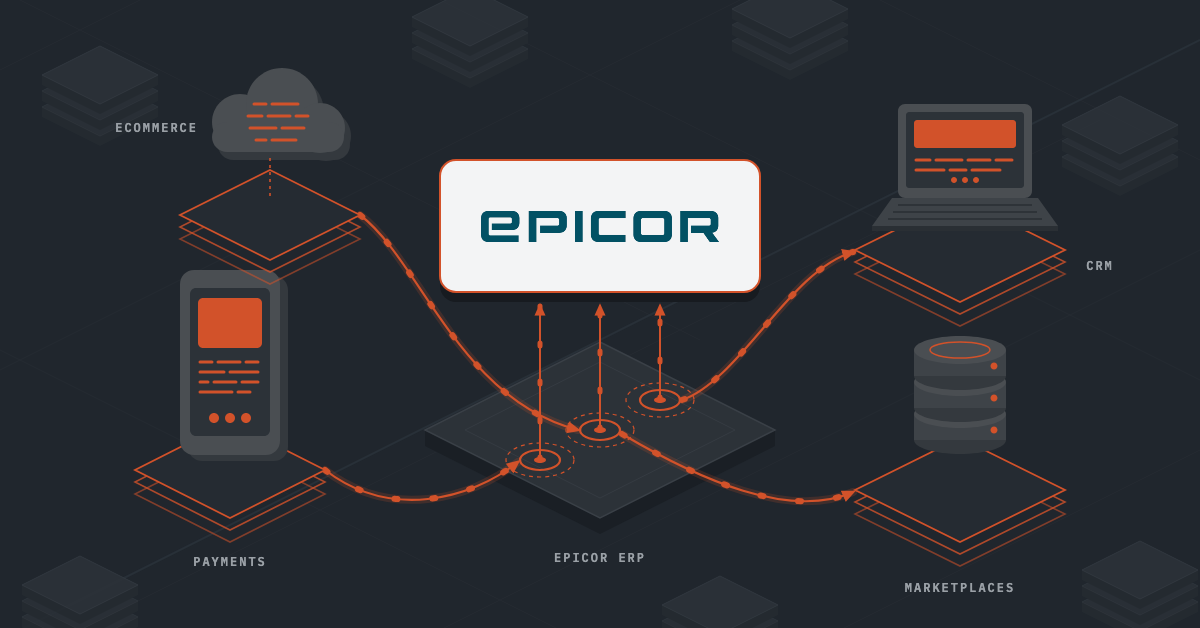
DCKAP is “the ERP-First Integration Platform Company.” It is built to help manufacturers and distributors build, connect, automate, and grow their business processes by making the ERP the central hub to which everything else connects: eCommerce platforms, CRMs, inventory, accounting, logistics, and marketplaces, rather than just another endpoint in the stack.
DCKAP has two products today: DCKAP Integrator (the core ERP integration solution) and DCKAP EDI (a dedicated electronic data interchange product for trading-partner transactions) are both built around the same ERP-first architecture rather than unrelated add-ons.
What makes DCKAP special is that it champions ERP-first integration for distributors and manufacturers.
DCKAP has dedicated its expertise and celebrated support for ERP integrations, along with platforms and systems preferred by wholesale distribution and manufacturing, so it could go deeper into the supply-chain management systems that the segment actually runs on.
DCKAP serves distributors and manufacturers in verticals including agriculture and landscaping, automotive and aftermarket, building materials, chemicals, electrical and electronics, food and beverage, industrial supplies and MRO, medical and dental, packaging and shipping, and plumbing/HVAC, not a horizontal list of buyers but a very deliberate, narrow one.
ERP Connectors Built for Distribution
DCKAP’s integrations list targets ERPs that are specific to the distribution industry and that other systems rarely prioritize. That includes Epicor Prophet 21, Epicor Eclipse, Epicor Kinetic, DDI/Distribution One, TrulinX, EvolutionX, and Global Shop Solutions, as well as more mainstream systems like NetSuite, Microsoft Dynamics 365, SAP, Sage, Infor, and Acumatica.
Front-end integrations include Magento, BigCommerce, Shopify, Salesforce, and HubSpot. DCKAP’s focus on distribution and manufacturing means the platform is not designed for plug-and-play, generic connectors or ERPs outside its niche.
Native EDI Management
APPSeCONNECT treats EDI as a workflow layer, while DCKAP markets it as a product in itself, DCKAP EDI. It natively supports ANSI X12, EDIFACT, TRADACOMS, XML, JSON, cXML, and CSV formats over AS2, SFTP/FTP, API, and VAN connections with named support for core transaction sets, including 810 (Invoice), 820 (Payment/Remittance), 830 (Planning Schedule), 846 (Inventory Inquiry), 850 (Purchase Order), 855 (PO Acknowledgement), 856 (Advance Ship Notice), 860 (PO Change), and 997 (Functional Acknowledgement).
DCKAP also provides pre-built retailer compliance for trading partners including Walmart, The Home Depot, Costco, Target, Lowe’s and Menards. In a published case study, distributor Tangent Technologies used DCKAP to eliminate a single VAN and reduce annual spend by about $250,000.
Pricing
DCKAP Integrator is promoted as a fully managed platform. Its team manages setup, monitoring, and maintenance, and customers have the option to not have to build or maintain the integrations.
The pricing for DCKAP Integrator and EDI is based on the complexity of your ERP and integration workflows. Talk to an integration expert to get a quote.
Case Studies and Trust Factors
DCKAP helps Distributor Premier Safety manage 9,000+ SKUs, 200+ attributes per SKU, 100+ categories, and 20+ customer groups across ERP, eCommerce, and product-content integration. Distributor Tangent Technologies cut approximately $250,000 in annual EDI spend and eliminated one VAN after switching to DCKAP.
Its customers typically realize a return on investment within 6 to 9 months of going live. On the trust side, DCKAP doesn’t store customer data or sell it to third parties. The business remains bootstrapped and founder-led rather than venture-funded. These are the points the company pitches as reasons it hasn’t wandered from its distribution-only focus.
Reviews
DCKAP Integrator has a 4.7/5 G2 rating based on 55 reviews, with particularly high ratings for Quality of Support (100%) and Ease of Use (99%). G2 has ranked DCKAP Integrator #1 for Ease of Use and Best Support in both its API Management and E-Commerce Data Integration categories. DCKAP is rated 4.7/5 overall on Gartner Peer Insights.
Best fit
If you’re a wholesale distributor or manufacturer using a distribution-specific ERP like Prophet 21, Eclipse, DDI, TrulinX, EvolutionX, or similar and need native, standards-based EDI tailored to your specific requirements and a fully managed integration team, not a self-serve platform to configure.
Conclusion
APPSeCONNECT now opens with the same “ERP-first” language DCKAP has naturally geared towards and spearheaded, but this change doesn’t mean the two platforms have merged into offering the same solution.
If your business doesn’t find itself in the distribution and manufacturing sectors, and your integration needs span a wide array of common business processes, its packaged pricing and AI agent roadmap are worth considering.
If you are a distributor or manufacturer looking to make your ERP a true single source of truth, and EDI compliance with big-box retailers does not fit your needs, DCKAP ‘s Integrator and EDI and single-industry focus are designed for that exact scenario.
Are you considering DCKAP Integrator for your ERP and EDI environment? Speak to DCKAP’s integration experts about your systems and trading-partner needs before selecting a platform.
Frequently Asked Questions (FAQs)
Does APPSeCONNECT support EDI the same way DCKAP does?
Not quite. DCKAP is offering EDI as a stand-alone product with native support for ANSI X12, EDIFACT, TRADACOMS, named transaction sets (810, 850, 855, 856, 997, and others), and pre-built retailer compliance.
APPSeCONNECT does not have a comparable dedicated EDI product or transaction-set catalog. Its published EDI-related content focuses on AI-assisted order validation and exception handling built on top of ERP workflows.
Which ERPs does each platform actually support natively?
APPSeCONNECT natively covers 15 ERP systems: SAP Business One, Microsoft Dynamics 365 Business Central, NetSuite, Sage 300, Acumatica, and SAP S/4HANA.
DCKAP Integrator supports those popular ERPs and distribution-specific systems like Epicor Prophet 21, Epicor Eclipse, DDI/Distribution One, TrulinX, EvolutionX, and Global Shop Solutions.
How long does it actually take to go live on each platform?
The timelines of the two are very different. APPSeCONNECT claims its predefined ready-to-deploy packages go live in two hours to three business days, enabling real-time data synchronization from day one.
DCKAP Integrator’s published plan comparison lists 7 weeks of onboarding for Standard, 8 to 12 weeks for Professional, and 12 to 16 weeks for Scale.
The difference indicates what each timeline involves: APPSeCONNECT’s window is for the configuration of a pre-built package to a single ERP-to-app pairing, while DCKAP’s longer timeline involves a fully custom-built, managed integration across a distributor’s specific systems and workflows.