If you’re exploring integration options for your business, you’ve probably come across point-to-point integration and hub-and-spoke integration, and also probably wondered what the actual difference is between the two.
In this blog, we’ll break down how these approaches work, where they overlap, how they differ, and which one may be the better fit for your business. We’ll also recommend a tool that supports both integration approaches in a seamless hybrid setup, so you can better understand what might work best for your operations.
Hub-and-Spoke vs Point-to-point Integration: Side by Side Comparison
| Aspect | Hub-and-Spoke | Point-to-point |
| Architecture | All systems connect through a central hub | Systems connect directly to each other |
| Data flow | Data passes through the hub before reaching destination systems | Data flows directly between systems |
| Scalability | Easier to scale as more systems are added | Gets harder to manage as integrations increase |
| Complexity | More organized and centralized | Can become messy over time |
| Flexibility | Better for managing multiple integrations centrally | Flexible for simple one-to-one integrations |
| Maintenance | Easier to monitor and maintain from one place | Each integration must be maintained separately |
| Implementation time | Slightly longer initial setup | Faster for smaller setups |
| Cost | Higher upfront investment | Lower initial costs |
| Monitoring and Visibility | Centralized visibility across integrations | Limited visibility across multiple connections |
| Risk factor | Hub can become a single point of failure | Failure usually impacts only connected systems |
| Best for | Growing businesses with multiple systems | Businesses with only a few integrations |
| Long term management | Easier to manage at scale | Becomes difficult as the business grows |
Hub-and-Spoke Integration vs Point-to-point Integration: Features, Pros and Cons
What is Hub-and-Spoke Integration?
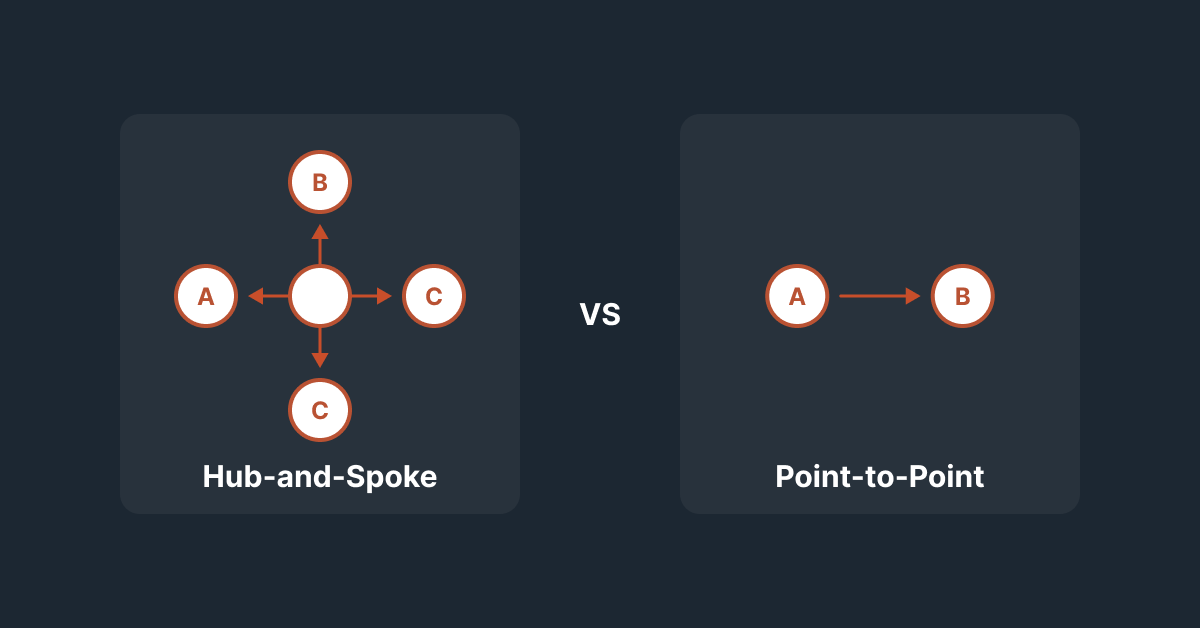
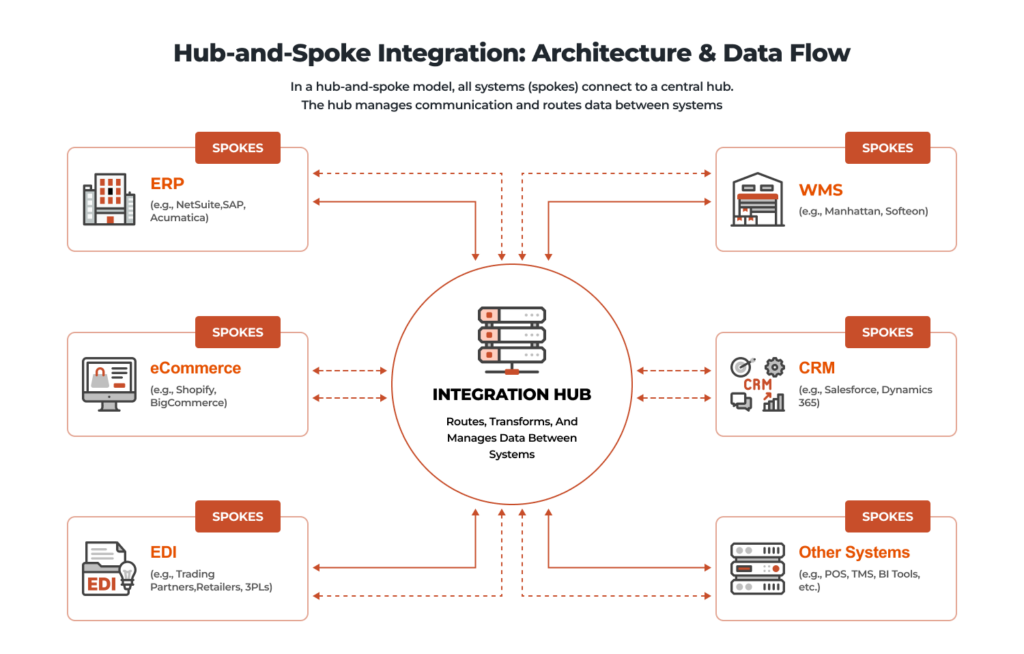
Hub-and-spoke integration is an architecture where all systems connect to a central hub that manages communication between applications. Instead of systems communicating directly with one another, every system sends and receives data through the hub.
The “hub” acts as the central controller, while the connected applications are the “spokes.” The hub is responsible for routing data between systems and managing integrations from one central point.
In this model, data flows from a source system to the hub first, and then the hub distributes that data to the appropriate destination systems.
Key Features
- One central hub manages all integrations
- Systems don’t connect directly to each other
- Easier to organize and monitor integrations
- Simplifies communication between multiple applications
- Centralized control over data movement
Pros
- Easier to manage than point-to-point integrations
- Cleaner and more organized integration structure
- Makes adding or removing systems simpler
- Good for companies with structured integration needs
- Centralized monitoring and control
Cons
- The hub can become a bottleneck if too much depends on it
- If the hub fails, multiple integrations can be affected
- Scaling can get difficult as complexity increases
- Less flexible for highly customized workflows
What is Point-to-Point Integration?
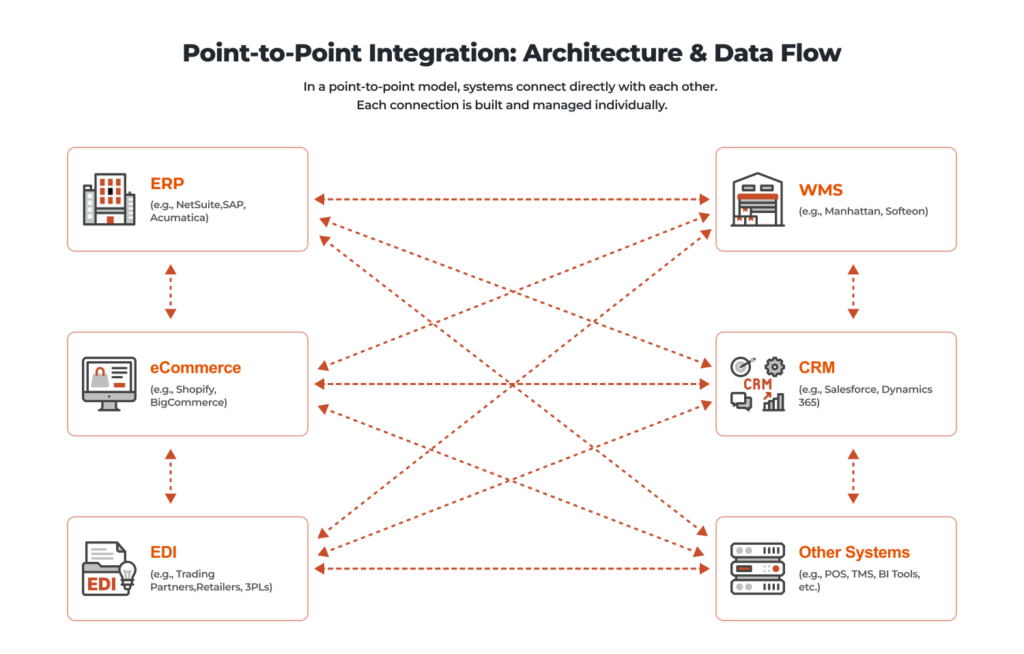
Point-to-point integration is exactly what it sounds like, one system connects directly to another system.
So, instead of having a central hub or integration layer managing communication, every connection is built individually between systems. For example, your ERP may connect directly to your WMS, CRM, eCommerce platform, or EDI solution through separate integrations. In this setup, data flows directly from one application to another without passing through a central platform.
At first, this can seem like a simple and cost-effective approach, especially if you only have a few systems. But as your business grows and more applications get added, the number of direct connections also increases and that’s where things can quickly become difficult to manage.
Key Features
- Direct connection between two systems
- No centralized integration platform or hub
- Each integration is built and managed separately
- Data moves directly between applications
- Typically simpler for smaller integration setups
Pros
- Faster and simpler to set up initially
- Lower upfront cost for small businesses
- Works well when only a few systems need to connect
- No need for a dedicated integration platform
- Direct communication can reduce latency in some cases
Cons
- Becomes difficult to manage as systems increase
- High maintenance effort with multiple integrations
- Changes in one system can affect several integrations
- Limited scalability for growing organizations
- Harder to monitor, troubleshoot, and standardize
- Can create a complex and messy integration environment over time
Also read: SFTP vs API Integration Explained: Pros, Cons, and Best Use Cases
Which Integration Model Is Better for Your Business?
There’s no one-size-fits-all answer here. The right integration approach usually comes down to how your business operates today and how you expect it to evolve over time.
Here’s a practical way to think about it:
Point-to-Point Integration Usually Makes More Sense If:
- You’re only connecting a small number of systems
- Your integration needs are straightforward
- You need something up and running quickly
- Your processes don’t change very often
- You’re solving for a specific integration need rather than building a long-term integration ecosystem
Hub-and-Spoke Integration Usually Makes More Sense If:
- Your operations involve multiple different systems working together
- Different departments rely heavily on shared data
- You’re planning to scale or add new apps over time
- Your workflows involve multiple touchpoints and automations
- You want more centralized visibility and integration management
- You’re balancing both legacy systems and newer cloud applications
So basically, if your integrations are relatively limited and stable, point-to-point can be a practical option. But if your business is growing, systems are increasing, and workflows are becoming more connected, hub-and-spoke integration is often easier to manage in the long run.
Also read: B2B EDI Integration Explained [+Top Solution for Distributors]
What If You Get the Best of Both Integration Approaches?
For many B2B business owners, choosing between point-to-point and hub-and-spoke integration isn’t always enough. As operations grow, businesses often need something that can go beyond the basics.
That’s where a hybrid integration approach becomes valuable. DCKAP Integrator is a good example of this. While it functions as a middleware platform, it gives businesses the organized structure of hub-and-spoke model without losing the flexibility and efficiency that make point-to-point integrations appealing in the first place.
Instead of creating multiple disconnected integrations, your ERP becomes the central hub of your business, while all other systems connect around it as spokes. This can include:
- WMS platforms
- CRM systems
- eCommerce platforms
- EDI solutions
- Supplier portals
- Third-party business applications
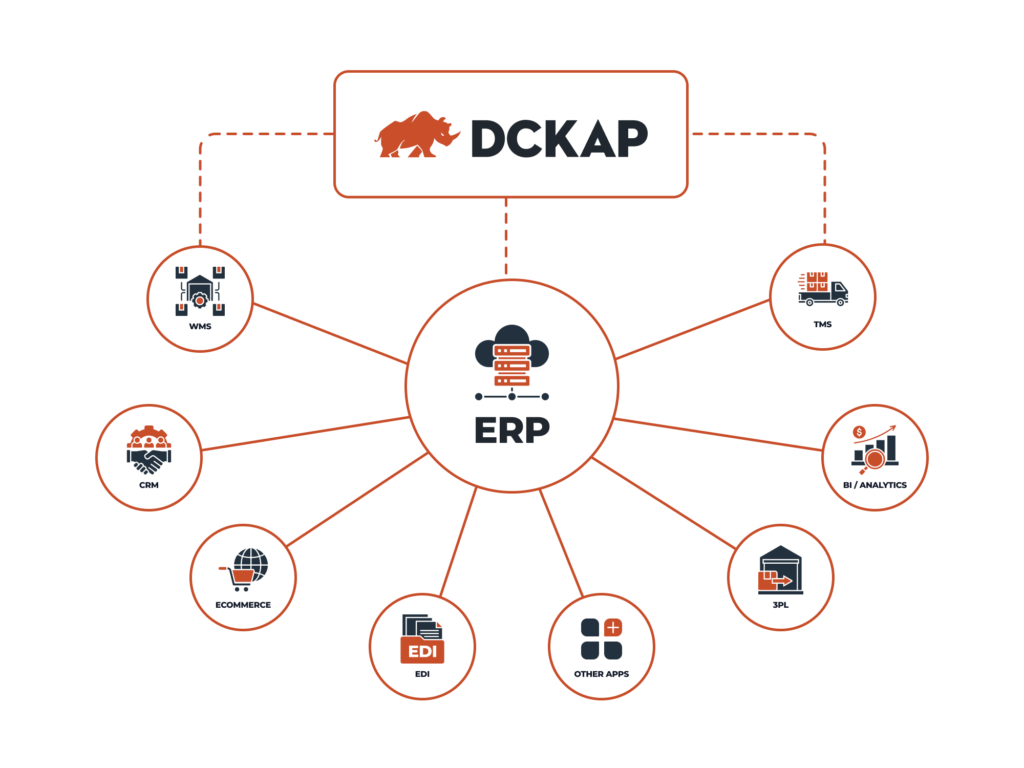
In this setup, data flows through a centralized ERP-first structure, making integrations much easier to manage, scale, and maintain as your business grows. What makes this approach different is that you get the advantages of both models in one setup:
- Centralized integration management
- Better scalability as systems increase
- Easier onboarding of new applications
- Cleaner data flow across departments
- More flexibility for automation and custom workflows
- Reduced complexity compared to multiple direct integrations
Instead of choosing strictly between point-to-point or hub-and-spoke integration, businesses can adopt a more flexible architecture that supports long-term growth without creating integration chaos later on. To know more about this tool, speak to one of our integration experts today and decide the best approach for your business.
FAQs
What is star integration?
Star integration is another term sometimes used to describe the hub-and-spoke model because all systems connect around one central integration hub, forming a star-like structure.
What are the biggest challenges with the point-to-point model?
The biggest challenges with the point model are maintenance complexity, custom code management, scalability issues, and troubleshooting multiple direct links between systems.
Is a hub-and-spoke model more expensive to implement?
The initial investment can sometimes be higher compared to simple point-to-point integrations, but many businesses see long-term cost savings through easier maintenance and scalability.
What questions should you ask before choosing the right integration approach?
Before choosing between a point-to-point approach, a hub-and-spoke model, or other integration solutions, businesses should evaluate how their systems, business processes, and various application data exchange requirements will evolve over time. Some important questions to ask include:
- How many systems need to communicate in real-time?
- Will future growth require more point-to-point connections?
- Are there existing data silos affecting operational efficiency?
- Will custom code be needed to support specific workflows?How important are scalability, flexibility, and data quality?
- Can the current setup support the latest features and future applications?
- Is the goal short-term implementation or long-term cost savings?
- Does the business rely on a direct link between only a few systems, or does it need a more centralized hub-and-spoke model?
Answering these questions early helps the client choose an integration strategy that supports both current operations and future growth without creating unnecessary delays or complexity later on.