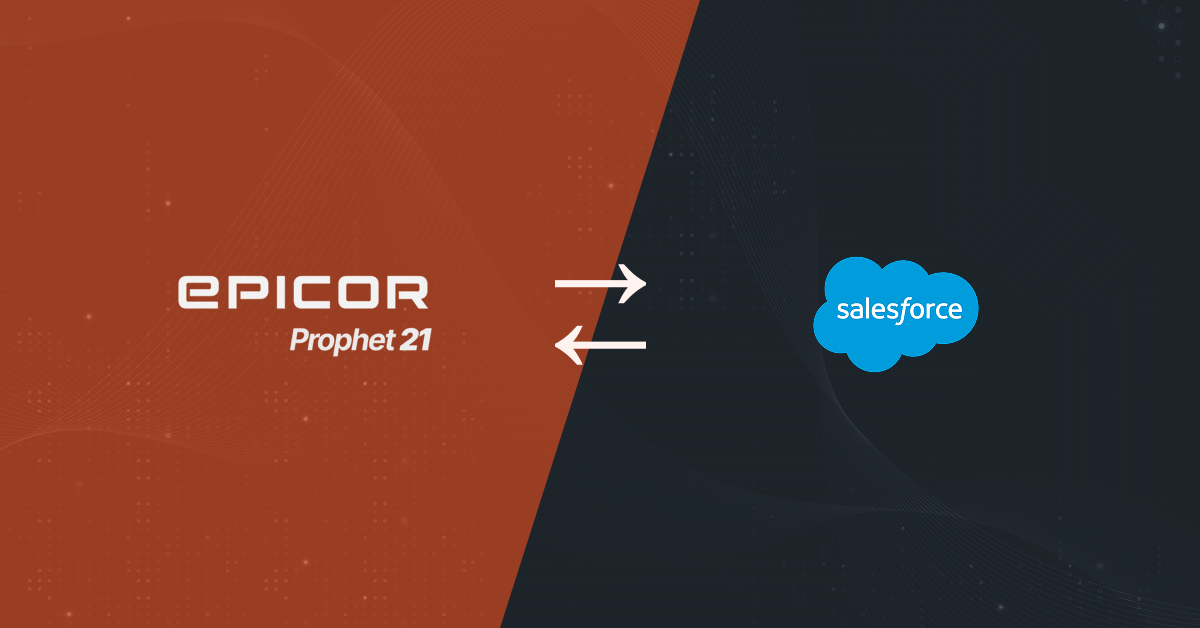
Combining the features of Salesforce and Epicor Prophet 21 can increase business profits and revenues. Salesforce is one of the leading Customer Relationship Management (CRM) solutions while Epicor Prophet 21 is a popular Enterprise Resource Planning solution designed for distributors.
The two solutions when integrated makes it possible to analyze customer behavior, discover hidden trends, and improve order management. It’s very possible for businesses to realize better financial outcomes based on their choice of decisions. Here is a simple overview of Prophet 21 and Salesforce integration:
Here’s a quick breakdown of Salesforce and Epicor Prophet 21 integration:
How to Integrate Prophet 21 and Salesforce?
1. Custom Code Integration
Custom code integration involves building a bespoke solution from the ground up using your own development resources. Rather than relying on a pre-built tool or platform, developers write scripts or applications that directly interact with the APIs of both Salesforce and Epicor Prophet 21 to move and transform data between them.
This approach gives organizations complete control over exactly how the integration behaves — every data mapping, every trigger, every transformation is defined by your team. It’s a good fit for businesses with highly specific or unconventional requirements that off-the-shelf tools can’t accommodate.
Key Advantages
- Full control – Every aspect of the integration is tailored to your exact business logic
- No vendor dependency – You’re not reliant on a third-party platform’s availability or pricing changes
- Highly flexible – Can accommodate edge cases and unusual data structures that pre-built connectors may not support
Trade-Offs to Consider
- High development cost – Building and testing a custom integration requires significant developer time upfront
- Ongoing maintenance burden – Any time Salesforce or Prophet 21 updates their APIs or data models, your custom code may need to be updated as well
- Limited visibility – Without investing in custom logging and monitoring, it can be difficult to detect and diagnose sync failures
- Longer time to value – Custom builds take considerably more time to deploy compared to connector-based or middleware solutions
Custom code integration is best suited for organizations with in-house development teams, unique integration requirements, or a strong preference for keeping infrastructure internal.
2. Connector-Based Integration
Connector-based integration uses pre-built connectors — purpose-built plugins or adapters designed specifically to link two platforms together. These connectors are typically developed and maintained by third-party vendors who specialize in a particular pair of systems, such as Salesforce and Epicor Prophet 21.
Unlike middleware (which is a broader platform capable of connecting many systems), a connector is a more focused, out-of-the-box solution designed to get two specific systems talking to each other with minimal setup.
Key Advantages
- Fast deployment: Pre-built connectors can often be set up in days rather than weeks or months
- Lower upfront cost: No custom development is needed to get started
- Maintained by the vendor: When Salesforce or Prophet 21 releases updates, the connector vendor typically updates the connector to stay compatible
- Predictable functionality: Common sync scenarios (customer records, sales orders, pricing) are usually supported out of the box
Trade-Offs to Consider
- Less flexibility: Connectors are built around common use cases; highly customized workflows may not be supported
- Vendor lock-in: Your integration depends on the connector vendor continuing to support and update their product
- Limited scalability: If your needs grow beyond what the connector supports, you may eventually need to migrate to a more robust solution
Connector-based integration is a strong choice for organizations that want a quick, reliable integration without significant development investment and whose workflows align well with standard use cases.
3. Middleware Integration
Middleware integration uses a third-party platform to act as an intermediary layer between Salesforce and Epicor Prophet 21. Rather than creating a direct, rigid connection between the two systems, middleware establishes a central hub through which all data flows — making it easier to manage, monitor, and scale your integrations over time.
This approach is often described as an Integration Platform as a Service (iPaaS), and it can connect far more than just two systems. A single middleware platform can bridge your ERP, CRM, ecommerce storefront, Product Information Management (PIM) system, Warehouse Management System (WMS), and more — all simultaneously.
Key Capabilities of Middleware Platforms
- Data Transformation: Middleware can reformat, remap, and restructure data as it passes between systems. This is critical when Salesforce and Prophet 21 use different field names, data types, or organizational structures for the same information (e.g., customer records, pricing tiers, or product codes).
- Event-Driven Triggers: Integrations can be set to fire automatically based on specific events — such as a new customer being created in Salesforce, an order being placed, or an inventory threshold being crossed in Prophet 21.
- Error Handling and Logging: Unlike point-to-point connections, middleware platforms typically include built-in error detection, logging dashboards, and retry logic. If a data sync fails, the platform captures the error and alerts the appropriate team rather than silently dropping data.
- Scalability: As your business grows and adds new systems or workflows, middleware makes it far easier to add new integrations without rebuilding existing ones from scratch.
- Bi-Directional Sync: Middleware manages the flow of data in both directions. Customer updates made in Prophet 21 can flow into Salesforce, and new leads or orders created in Salesforce can flow back into the ERP.
- Scheduling and Real-Time Sync: Depending on business needs, middleware can be configured to sync data in real time (as events occur) or on a set schedule (e.g., every hour or nightly batch).
When to Choose Middleware
Middleware is the better choice when:
- You need to connect more than two systems
- Your data structures between platforms don’t match cleanly and require transformation
- You require robust error handling and visibility into sync activity
- Your integration needs are likely to grow or change over time
- You want to minimize the need for custom development and ongoing maintenance
- Data loss prevention is a priority (e.g., ensuring sales orders are never dropped during sync)
Trade-Offs to Consider
While middleware offers significant advantages, it does introduce some considerations:
- Cost: Middleware platforms typically involve a subscription fee, which adds to your overall tech stack cost
- Setup Time: Initial configuration can require more upfront effort compared to a simple connector-based solution
- Vendor Dependency: Your integration becomes reliant on the middleware provider’s uptime and support quality
For most mid-sized distributors managing multiple systems, the benefits of middleware, including reliability, scalability, and reduced manual effort, far outweigh these trade-offs.
Related read: The Definitive Guide on ERP Integration with Salesforce
Why Choose A Prophet 21 & Salesforce Integration?
Here are a few reasons why you should consider Prophet 21 and Salesforce integration:
1. Save Time:
- Integration allows employees to work with seamless data flow and spend less time switching between different platforms, increasing general productivity.
- It also saves time and effort through the elimination of manual data entry.
2. Get Real-Time Reporting:
- Salesforce integration empowers you with real-time access to sales data from the Epicor Prophet 21 system.
- One can make smart decisions on the basis of data lying at the centralized platform of Salesforce regarding customer relations and the launching of new products.
3. Automate Support for Lead Nurturing and Engagement:
- It has the features of lead management from Salesforce.
- Set up automated lead nurturing and engagement strategy based on specific criteria.
- Design custom workflows. Specific actions could be email campaigns or SMS messages for better conversion.
4. Reduce Error Rate:
- The integration reduces errors in reporting and analysis since the consolidation of data.
- You can identify and rectify errors quickly since all the sales information is instantly available.
Also see: Shopify Epicor Prophet 21 Integration: How It Works
Top Challenges Associated with Epicor P21 & Salesforce Integration
The most common challenges associated with integrating Salesforce and Epicor Prophet 21 are:
- Integration between Epicor Prophet 21 and Salesforce is a two-way street. This means that you must ensure that the data entered into the system is consistent with what is imported from Salesforce.
| With an ‘Advanced Mapping’ feature, as available in the DCKAP Integrator, you can easily mitigate this challenge, by mapping the different data and letting the tool transfer the data as intended. |
- The integration between the two systems must be flexible enough for future updates and changes in both systems. If either system has a significant update or upgrade, it will affect the other system. This can be avoided by ensuring that all changes made to both systems are done through an automated process that allows for testing before they are rolled out to production or live environments.
- It is recommended to use a third-party application to provide data synchronization between Salesforce and Epicor Prophet 21 so that there is no important data loss (such as sales orders) during integration and maintenance processes.
DCKAP Integrator: Simplifying Integration for Distributors
DCKAP Integrator is a cloud-based integration tool, specifically made for distributors. It has the required expertise and ability to connect Epicor Prophet 21 with Salesforce. With DCKAP Integrator, you can keep all your business data in one place and see everything clearly. It becomes the single source of truth eliminating the need for multiple software solutions. It makes sure Epicor P21 and Salesforce CRM talk to each other smoothly.
It works with all the important parts of Epicor Prophet 21. Plus, it’s made to be simple yet strong. You can try it out with a demo customized just for you. Here are some of the features that set it apart from others:
- User-friendly and Intuitive Interface
- No learning curve
- Advanced data mapping features that empower users to personalize data synchronization.
- Real-time synchronization to keep the platforms at par with the same information.
- Comprehensive reporting and analytics for business insights.
- Third-party extensions and plugins are easily integrated.
Case Study: Epicor Prophet 21 and Salesforce Integration with DCKAP Integrator
After the sales department at CB Pacific upgraded to Salesforce CRM, they needed an integration solution to sync information between the CRM and their Prophet 21 ERP.
The DCKAP Integrator has provided comprehensive integration solutions to automate their customer base data, the quotes and orders frequently placed by other distributors, and since the CB Pacific Team is dedicated to manufacturing and supplying manufactured parts, the integration automates the sales opportunities related to their manufactured parts as well.
FAQs
Is Prophet 21 an ERP solution?
Epicor Prophet 21 is an all-inclusive ERP software that intends to ease business processes and operations overall, with special consideration given to wholesale distribution.
What are the benefits of integrating Epicor Prophet 21 and Salesforce?
Integration of Epicor Prophet 21 and Salesforce offers a number of benefits, including business visibility, customer relationship management, order management, improved financial management, and supply chain management.
What are some use cases for Epicor Prophet 21 and Salesforce Integration?
Use cases for integration include synchronizing customer data between ERP and CRM systems, automating sales order creation and processing, tracking inventory levels and sales performance, and generating insightful reports for informed decision-making.
Which ERP works best with Salesforce?
When it comes to ERP integration with Salesforce, several options work well together. However, popular choices include systems like SAP, Oracle NetSuite, Microsoft Dynamics 365, and Epicor Prophet 21. These ERPs offer robust capabilities and seamless integration possibilities with Salesforce.