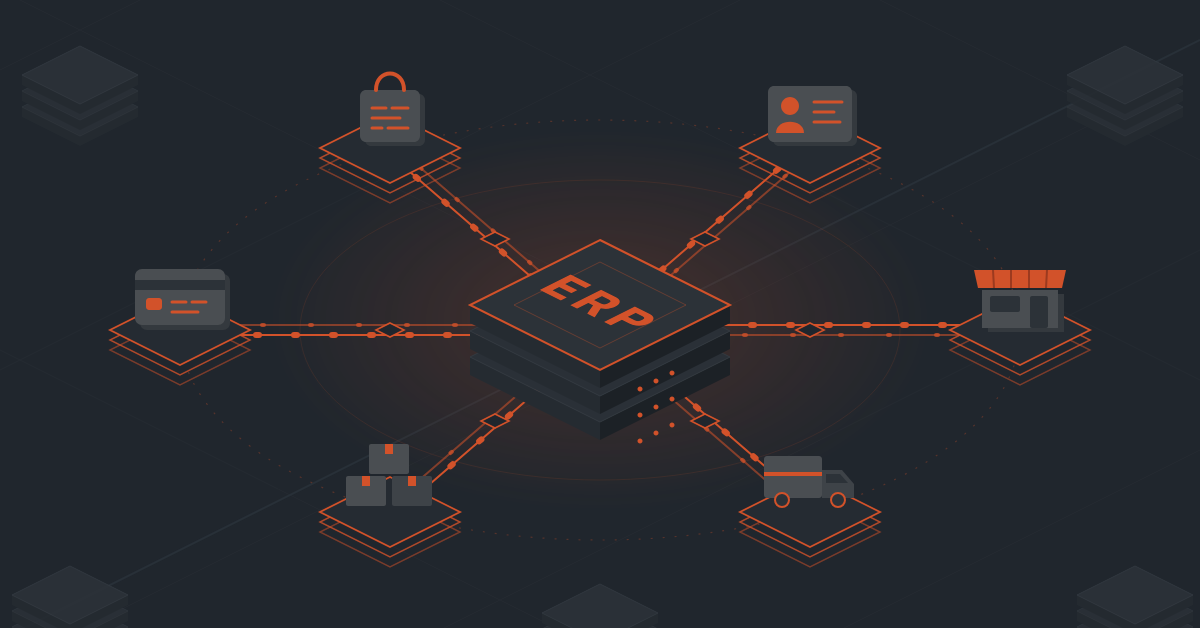
Distributors across the board are connecting their ERP to the other software their business runs on, so data moves between them automatically instead of being re-keyed by hand. Because the ERP holds the information everything else depends on, and when other systems can’t see that data, you get duplicate entry, outdated stock levels, pricing mistakes, and teams working from different versions of the truth.
Integration fixes that by keeping everything in sync, which saves time, cuts errors, and gives customers and employees accurate, real-time information. The systems most commonly connected to an ERP include eCommerce platforms and B2B portals, CRMs like Salesforce or HubSpot, trading partners and EDI, shipping tools, accounting and payment software, marketplaces like Amazon, EDI for trading partners, and business intelligence or databases. Done well, it turns your ERP from a back-office record keeper into the connected hub of your whole operation.
Here are examples of common use cases we’ve come across as experts in ERP integration, along with real-life case studies of challenges that DCKAP was able to solve for distributors and manufacturers.
eCommerce & ERP Integration Use Cases: The Baseline and Its Exceptions
The baseline is familiar enough, with products, inventory, and pricing going down to the storefront and orders coming back up, and what really changes from one project to the next is how much the ERP lets you reach.
At Wichita Industrial Sales, which supplies construction, manufacturing, and oilfield customers in North Texas and Southern Oklahoma, the ERP was DDI Inform, and it didn’t have modern APIs for customer or product data, so parts of the build needed custom workarounds.
The product data needed attention too, because images were kept in a separate PIM, units of measure didn’t always match, and some descriptions had been cut short. They were also moving from Magento to EvolutionX, with over 14,000 products to migrate.
Five pipelines run in batch mode. Customer-specific pricing is the dynamic one, and if the system can’t resolve a price, it shows “Call for Price” instead of guessing.
Magnuson Superchargers make superchargers for the automotive aftermarket and sell on Shopify to consumers as well as to around 150 dealers, but Global Shop Solutions, the ERP behind it, has no native REST API, so we ended up writing custom APIs and staging tables around the GSS data model and then working through the firewall, whitelisting, VPN, and RDP setup with their hosting provider.
Pricing was the real problem. Dealers were already seeing a discounted price in Shopify, and GSS would then add its own price-class discount on top, so the integration had to keep the two apart or dealers would have been discounted twice.
Dealer orders are matched to the right GSS account using the company ID in Shopify, and anything without one goes to a retail account. We sorted the few issues that came up after go-live in just a few days.
If your ERP is older or on-premise, the first few weeks will probably focus on getting access, and pricing rules tend to come right after, because that’s usually where storefront and ERP logic run into each other.
One ERP, Several Storefronts
A second store means more than a second set of pipelines. Action Spa Parts sells spa and pool parts on Shopify and WooCommerce with distribution. Before we got involved, their staff was re-keying orders from both sites, copying wholesale prices over by hand, and customers weren’t getting tracking numbers at all.
Today, Shopify has five workflows, and WooCommerce has six, but they don’t follow quite the same rules: a new product lands in Shopify as a draft, while in WooCommerce it’s set to private until somebody reviews it.
According to the case study, order processing got up to 95% faster, fulfillment errors dropped by about 85%, and shipping inquiries dropped by about 75%, with an estimated 20 to 25 hours a week saved.
If you sell through more than one storefront, it helps to plan each channel’s rules on their own, because the ERP stays the same while the way each store wants things handed to it doesn’t.
Also see: DCKAP’s ERP-First Integration Approach Explained
CRM: Getting ERP Data To The Sales Team
CRM work usually starts with one question: what does a rep need to see without logging into the ERP?
At ACI Controls, a distributor of automation and process control equipment, quotes were being created in TrulinX while the sales pipeline lived in HubSpot, so a deal could still look open in HubSpot long after it had become an order.
Now every TrulinX quote opens a HubSpot deal at “Quote Sent,” and the integration creates the contact or company if it isn’t there yet, assigns the rep from TrulinX territory mappings, and moves the deal to “Closed Won” once the quote turns into an order.
AE Global had two ERPs feeding one CRM. Their Distribution One instance syncs straight into Salesforce, starting with over 7,000 customer records and more than 30,000 order and invoice records, with product costs refreshed every few minutes, while NetSuite, which belongs to another business under the same umbrella, doesn’t go through an API at all and instead drops CSV files that are put into an FTP folder that the Integrator picks up on a schedule.
As their Salesforce admin Nathaniel Bullock put it, “They no longer have to log into our ERP, which is desktop-based and clunky.”
If you’re connecting a CRM, it’s worth deciding early which way each record flows. In both of these builds, orders and pricing stay in the ERP and simply show up in the CRM.

EDI: Trading Partners Without A VAN
The EDI filter lists Canadian Tire, Costco, Home Depot, Menards, Snap-on, Walmart, and Wayfair, and almost all of them lead back to one client.
Tangent Technologies makes recycled plastic lumber and runs Infor SyteLine, and what they wanted was to stop paying the per-transaction and per-partner fees that traditional EDI usually comes with. Wayfair is connected API to API, while the other five retailers send EDI that gets translated into API calls SyteLine can accept, and every 997 acknowledgment is logged.
The Customer Stories page lists Tangent’s result as $250k less in annual spend, and John Zei, their VP of IT, said in the case study that DCKAP helped them “find hard cost savings compared to the more traditional approaches of an EDI VAN.”
The scope at Mills Office Productivity, a family-owned office supplier in British Columbia, is much smaller. Grand & Toy sends 850 purchase orders into Acumatica and Mills returns 856 ship notices and 810 invoices, the 856 being the document X12 says “ties the order to the delivery process” in its supply chain flow.
The harder part at Mills was the storefront, where six Acumatica-to-EvolutionX pipelines put enough strain on the ERP that we had to add staging areas and control mechanisms.
If you trade over EDI, the 850, 856, and 810 are the places to start, and it’s worth asking whether any of your partners will take API instead, since every one that does is a document you stop paying a VAN to carry.
Payments Integration
Lendin Merchant Services is the one project in this roundup that doesn’t involve an ERP. Lendin handles payments for franchise locations in the Unishipper network, and their payment platform was being shut down on March 31, 2026, so there was a fixed date to work toward.
We built five workflows between Unishippers and CardChamp that cover customer and invoice sync, a daily autopay run on invoices that come due, payment confirmations going back to Unishippers, and bulk enrollment into autopay.
Unishippers sends one master file for every franchise, including merchants that use other payment providers, so the integration has to filter out everyone who isn’t Lendin’s, and because card and ACH payments are priced differently, that logic is built in as well. New franchises go through a standard onboarding setup rather than a custom build each time.
At North South Supply, an irrigation and landscape lighting distributor, the problem was on the ERP side, with staff capturing card payments on the CardConnect site and then typing the authorization into Prophet 21.
The Integrator now takes the transaction ID, captures the payment, and writes the authorization back, and their Director of Information Systems, John Suit, said it has “become practically invisible to us.”
If payments are on your list, map out the pricing rules and the reconciliation step before you get to the API calls. That’s where both of these projects spent their effort.
Warehouse And Shipping Integration
Williams Trading Co. stocks over 17,000 products, and its warehouse ran on Distribution One’s built-in module over Windows Remote Desktop on consumer tablets, with dropped connections and unreliable input. When they chose Deposco as the new warehouse system, it was Distribution One that suggested DCKAP Integrator to connect it.
There are seven pipelines in all, running in batch and covering everything from products and orders through to shipping and vendors. Staff work from handhelds, managers get warehouse metrics they didn’t have before, and the Williams IT team watches the syncs themselves. Their IT administrator John Halterman said they resolved issues very, very quickly.
At Aliquantum International, which also runs Distribution One, ShipStation and ChannelAdvisor (now called Rithum) were added around an older ERP that doesn’t offer much in the way of APIs. ShipStation gets inventory and returns tracking numbers. ChannelAdvisor sends its marketplace orders into the ERP and gets inventory, pricing, and shipping updates back.
If you’re adding a WMS or a shipping tool, sort out which system owns which record before anything else. At Williams, products and orders start in the ERP, and inventory and shipping start in Deposco.
Databases and data layers
CFM Equipment Distributors, an HVAC distributor founded in 1984, moved to P21 cloud and found API access tied to a static IP. Their IP kept changing, so they had to ask for access again every time it did, and daily CSV exports became the workaround, which made dashboards or a B2B ordering portal a lot harder to build.
These days P21 sends its core data over to Supabase every five minutes, from customers and products through to invoices and customer pricing, with the static IP sitting on our side and calls paced so they stay within P21’s API limits. The portal reads from Supabase rather than hitting P21 on every request.
CyM Distributors is a bit of an outlier, since there’s no ERP API involved at all. They’re an auto parts wholesaler that has served Puerto Rico and the Caribbean since 1987; their source of truth is a MySQL database, and Magento 2 reads from and writes to it directly.
If your ERP’s API is what’s holding things back, putting a separate data layer in front of it can take a lot of the read traffic off.
Marketplaces and procurement
C. W. Hayden Co. has been selling industrial and marine products since 1948 and is listed on the 3M Marketplace, which runs on Mirakl, so offers and inventory go out from Prophet 21 and orders come back in. We also added a feature that approves 3M orders automatically and lets the team know, which saves them hours of clicking around in Mirakl.
Quad City Safety runs the procurement version, where purchase orders from TK Elevator come in through Jaggaer and pass through EvolutionX into Prophet 21, and then confirmations, shipping details, ASNs, and invoices make their way back to Jaggaer on a schedule.
If a customer buys from you through a procurement platform, most of the work happens on the return trip, getting confirmations and invoices back to where they expect to find them.
When the ERP Itself Changes
HOTWORX first hooked Magento up to Microsoft Dynamics GP back in 2022. GP had no native API, and their previous integration provider was slow to respond. When the spa franchise moved to Sage X3 in 2024, the Sage team already had the APIs ready; the integration was moved across in two to three weeks, and the case study records no disruptions.
If an ERP change is coming, keeping the integration in middleware instead of point-to-point is what makes it a repointing job rather than a rebuild.
Where DCKAP Integrator Fits
Put it all together, and you see the same few patterns.
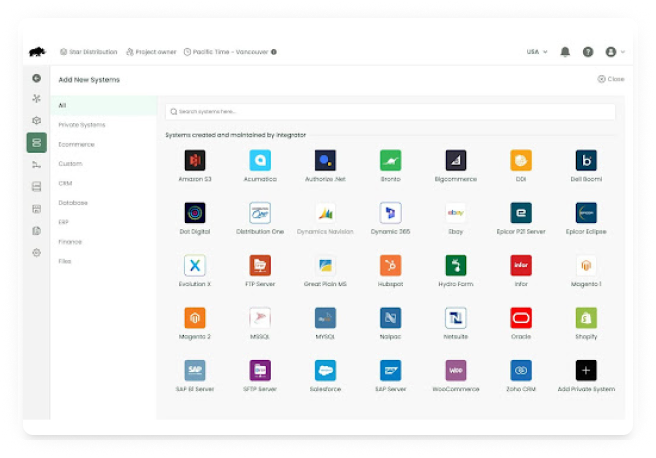
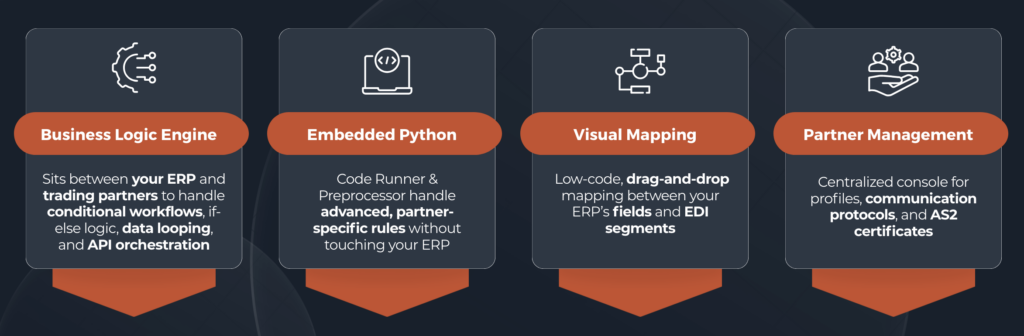
- One system stays in charge. Usually that’s the ERP, but it might be a MySQL database or a billing platform like Unishippers. Adding something new to DCKAP Integrator, whether a WooCommerce store or a Walmart feed, it just means adding pipelines. Nobody has to redesign anything.
- Each pipeline gets its own timing. At Wichita, the catalog syncs in batches and pricing happens live. At Tangent, Home Depot purchase orders come in dynamically, while ship notices and invoices go out in batches.
- No usable API? We write one. That’s what we did for GSS at Magnuson, and DDI Inform at Wichita.
- EDI and API run side by side. Tangent has both on the same platform, and DCKAP EDI covers trading partner work.
- Clients can see what’s going on. Williams Trading’s IT team troubleshoots and syncs themselves, and CFM has full admin access to its workflows.
Conclusion
The ERP filter tells you what sits at the center of a project, but the other filters are where you see the actual work, whether that’s a dealer discount being applied twice, a retailer that will only accept EDI, a franchise network that sends everything in one file, or an API that only answers to one IP address.
If your setup looks like any of these, talk to an integration engineer or filter the Customer Stories by the systems you’re running.
FAQs
Does DCKAP Integrator require an ERP?
No. Lendin Merchant Services connects a shipping company’s billing system to a payment processor, and CyM Distributors syncs Magento 2 directly with a MySQL database.
Can EDI and API integrations run on the same platform?
Yes. DCKAP offers a platform that offers both types of integration and more, allowing you to use a single platform as a solution for varied data sync needs. For example, Tangent Technologies connects Wayfair over API and five other retailers over EDI to one Infor SyteLine ERP.
What is the difference between batch and dynamic sync?
A batch pipeline runs on a schedule. CFM, for example, syncs P21 to Supabase every five minutes. A dynamic pipeline runs on demand, as Wichita Industrial’s pricing does, which pulls a customer’s contracted rate live from the ERP.
How long does an integration take to go live?
That depends on the scope. On the pricing page, the entry-level Launch plan lists seven weeks of onboarding. Our FAQ gives the three things that change the timeline: the number of data points, how much customization you need, and whether a custom API has to be built.
How is DCKAP Integrator priced?
It’s a flat fee. You won’t be charged per record or per transaction, as the pricing page explains. The fee depends on how many systems you connect and how complex the workflows are. Setup is billed separately and covers everything from discovery through testing and launch.
What if one of my systems doesn’t have a pre-built connector?
We can still connect it. Per our pricing FAQ, the options include REST APIs, SOAP web services, direct database queries, flat files, FTP, or EDI. Custom, legacy, and on-premises systems need some extra scoping. Pre-built connectors are generally cheaper to set up.
Who will maintain the integration after go-live?
We do. In what our pricing page calls the Maintain phase, we monitor your integrations, fix sync errors, keep up with vendor API and software updates, and adjust workflows as your business changes. From your team, we mainly need system access and someone to confirm the mapping and business logic early on.