Running an online store at scale means keeping orders, inventory, fulfillment, and financial data in sync. When these processes are spread across different systems or managed manually, businesses can run into overselling, shipping delays, inventory errors, and accounting issues.
Microsoft Dynamics 365 Business Central is an ERP designed for small and mid-sized businesses that brings finance, inventory, operations, sales, and supply chain processes into one system while platforms like Shopify, Magento, WooCommerce, and BigCommerce handle the customer-facing experience. Let’s look into the product in further detail.
Understanding Microsoft Dynamics 365 Business Central
Microsoft Dynamics 365 Business Central is a cloud-based ERP that evolved from Microsoft’s Dynamics NAV product.
It brings key business functions into one system, including:
- Financial management
- Inventory and warehouse management
- Order processing
- Purchasing and supply chain
- Sales and customer management
- Reporting and analytics
For distribution businesses, Business Central can act as the single source of truth for products, inventory, orders, pricing, customers, and financial information.
What to Expect from Business Central Costs
The cost of Microsoft Dynamics 365 Business Central goes beyond the software license. Your total cost will depend on the number and type of users, implementation requirements, ecommerce integrations, third-party apps, data migration, and ongoing support.
For a straightforward implementation, costs are generally lower because there is less customization and fewer integrations involved. As your business grows and you add multiple sales channels, complex workflows, custom integrations, or advanced reporting, implementation and ongoing support costs can increase.
The main costs to plan for are:
- Business Central licenses based on user access and functionality
- Implementation and setup, including configuration, data migration, and training
- eCommerce integration with your online store and other sales channels
- Third-party apps for areas such as tax, shipping, or specialized workflows
- Ongoing support and maintenance for troubleshooting, updates, and future changes
The best way to estimate your actual cost is to first define your users, business processes, integrations, and customization requirements, then get a quote based on your specific setup rather than relying on a standard license price.
What Are the Benefits of Using Business Central?
1. Better Inventory Management
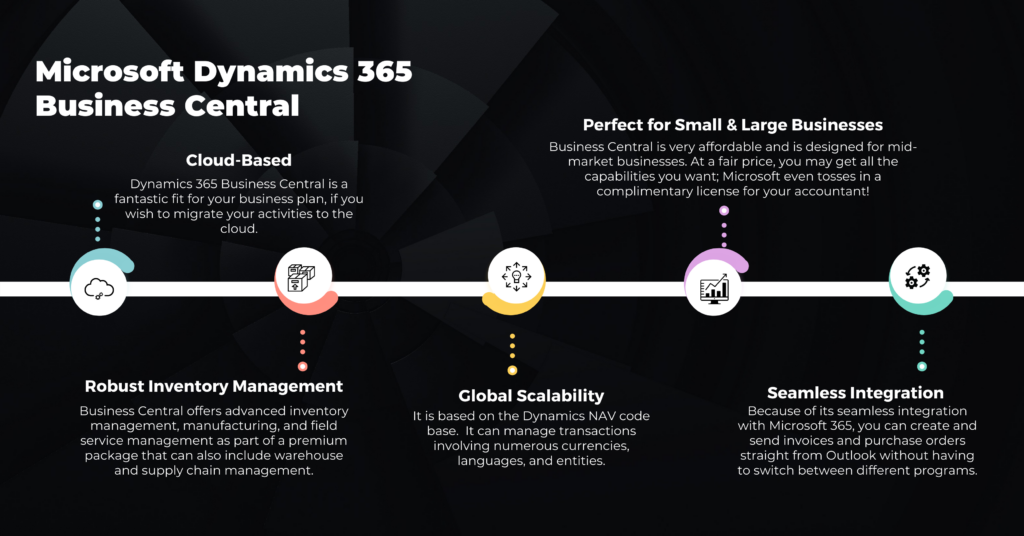
Business Central gives businesses a central view of inventory across warehouses and sales channels. This helps reduce overselling, stockouts, and inventory discrepancies.
2. Streamlined Order Processing
Instead of manually moving orders between systems, orders can flow from the online store into Business Central. From there, the business can manage fulfillment, shipping, invoicing, and related financial processes.
3. Support for B2B and B2C Sales
Business Central can support both online retail and complex B2B workflows, including:
- Customer-specific pricing
- Volume discounts
- Credit limits
- Net payment terms
- Different product and pricing rules for different customers
4. Multi-Currency and Multi-Entity Support
Businesses selling across different markets can manage multiple currencies, entities, and financial requirements within Business Central.
5. Better Planning and Reporting
Business Central brings sales, inventory, purchasing, and financial data together, giving teams better visibility for reporting, forecasting, and business decisions.
Methods for Integrating Business Central with eCommerce
Business Central can be connected to Shopify, Magento, WooCommerce, BigCommerce, and other ecommerce platforms in several ways.
1. Native Connectors
These connect Business Central directly with supported ecommerce platforms and handle common data such as products, inventory, customers, orders, pricing, and fulfillment. Best for businesses with standard integration needs and a supported platform.
2. iPaaS / Middleware
An integration platform sits between Business Central and external systems to manage data mapping, synchronization, error handling, and monitoring. Managed iPaaS providers can also handle implementation, maintenance, and customizations. Best for businesses with multiple sales channels, complex workflows, or specific distribution requirements.
3. Custom API Integration
Businesses can build custom integrations using Business Central APIs, REST, OData, and AL development. This provides more control but requires more development and ongoing maintenance. Best for businesses with proprietary platforms or highly customized integration requirements.
Key Considerations Before Implementing Business Central
Clean Your Data First
Before moving data into Business Central, clean up product, customer, SKU, and inventory data. Duplicate records, inconsistent SKUs, and incorrect units of measure can create problems later.
Define Your B2B and B2C Workflows
Decide how B2C and B2B orders should be handled. B2C orders may use a common customer setup with immediate online payment, while B2B orders may need customer-specific pricing, credit checks, approval workflows, and payment terms.
Plan Your Warehouse Strategy
Define how inventory will be shared across warehouses, stores, ecommerce channels, and 3PLs. You should also decide how inventory will be allocated, reserved, picked, and shipped.
Avoid Unnecessary Customization
Start with standard Business Central functionality wherever possible. For specialized requirements, consider certified extensions and add-ons before building custom functionality.
Choose the Right Implementation Partner
Look for a Microsoft Solutions Partner with experience in ecommerce, distribution, and supply chain, not just general ERP implementations. The partner should also support testing, training, data migration, and post-launch optimization.
Top Solution to Integrate Microsoft Dynamics 365 Business Central: DCKAP Integrator
DCKAP Integrator helps connect Microsoft Dynamics 365 Business Central with ecommerce platforms, marketplaces, CRM, WMS, and other business systems. It takes care of the technical work involved in integration, including implementation, data mapping, synchronization, monitoring, troubleshooting, and ongoing maintenance. Here’s how it impacts your business:
Centralizes Data
eCommerce and CRM systems work with data that is not always available in a single place. Even if you have a large number of customers and sales reps, it can be difficult to track all of their contacts and activities. With Microsoft Dynamics 365 Business Central integration, you can connect all of your customer contacts and activities from one system. You’ll be able to visualize all of this information at once, making it easier for your team to make decisions based on real-time information.
Ensures Data Driven Decision Making
It’s not enough for managers to have access to all of their own data; they also need access to relevant data from other sources. If you don’t have the right information at your fingertips, you’ll never know when something important has changed or what needs attention next, which means you’re less likely to make appropriate decisions. With DCKAP Integrator, it will be easier for managers to take advantage of relevant information that could help them make better decisions related to sales, marketing and customer service.
Augments Sales Funnel optimization
When you use DCKAP Integrator to connect your Microsoft Dynamics 365 Business Central with eCommerce & CRM, you can easily create a customer journey and enhance your sales funnel optimization. You can also create different types of customer journeys based on the type of business that you are running. This is done by creating different user roles in Microsoft Dynamics 365 Business Central as a part of this process.
Prioritize Goals & Tasks
You can prioritize your goals and tasks in an effective manner by using DCKAP Integrator to connect your Microsoft Dynamics 365 Business Central with eCommerce & CRM. This will help you achieve your business goals faster and more efficiently.
Enhances Flexibility & Customization
DCKAP Integrator provides a lot of flexibility in customizing your ERP with eCommerce functionality. By combining the two systems, you can create customizations like adding different product types and extending the functionality to multiple products.
Choosing the right ERP system matters a lot in Microsoft Dynamics 365 Business Central is an all-in-one business management solution that’s perfect for small businesses. It’s easy to set up and use, and it provides everything you need to run your business, including invoicing, accounting, and sales automation. Moreover, the integration capabilities is what makes Microsoft Dynamics 365 Central the best in-class-breed among the ERPs in thee market. So if you are using Microsoft Dynamics 365 Business Central, get in touch with DCKAP to start your integration process.