For businesses in the manufacturing and wholesale distribution industries, standard “one-size-fits-all” automation tools often fall short when dealing with complex, high-volume operational workflows. Both DCKAP and Kore Technologies have developed highly specialized software to solve this exact problem.
However, their underlying architectural philosophies, core strengths, and engineering focuses are vastly different. Read on to know the difference.
DCKAP vs. Kore Technologies: Key Differences at a Glance
| Aspect | DCKAP | Kore Technologies |
| Integration tool | DCKAP Integrator | Kore Integrate |
| Product overview | ERP-First Integration Platform, a cloud-based hub built specifically to help distributors and manufacturers make their systems talk to each other. | Enterprise Data Management & Integration, an engineering platform built to modernize backend data, manage databases, and help legacy systems last longer. |
| Core business purpose | Automate Business Processes. Eliminates manual data entry and errors by keeping front-end channels (like eCommerce and CRM) and back-office ERPs perfectly synced. | Data Transformation & Moving. Focuses on sorting, cleaning, and translating massive, complicated corporate backend data files from one database style to another. |
| Approach | Positions your core distribution ERP (like Epicor Eclipse/Prophet 21, Infor, or Sage) as the absolute central hub so everyone works from the same accurate information. | Extracts data from different business systems to build an external, near-real-time SQL data warehouse used for advanced corporate reporting and analytics. |
| Primary data movement | Real-time and batch sync | High volume ETL processing |
| Troubleshooting style | Detailed Loggers & Console Logs, simple, visual tracking dashboards so regular business employees can spot a failed data transfer and fix it with a few clicks. | Developer Packages built for IT teams, database administrators, and programmers who want code-level control over data definitions and mapping rules. |
| Pricing model | Custom pricing plans, with costs tailored to your systems, trading partners, workflows, and custom requirements. | Pricing is custom-fit based entirely on the size, complexity, and server setup of an enterprise’s legacy data footprint. |
DCKAP Integrator vs Kore Integrate: Features, Pros and Cons
DCKAP Integrator (by DCKAP)
DCKAP Integrator is a cloud-native, ERP-First middleware. It is specifically designed to centralize a distributor’s entire multichannel business ecosystem around their core ERP (such as Epicor Prophet 21, Infor, Microsoft Dynamics, or Sage), automating real-time operational workflows.
Key Features
- ERP-First Architecture: Positions the ERP as the single source of truth; all external platforms (ecommerce, CRM, PIM, logistics) sync directly through the central ERP pipeline rather than in messy point-to-point connections.
- Visual Low-Code Flow Builder: Features an intuitive drag-and-drop dashboard where users configure pipes and integration logic flows without needing to write custom queries from scratch.
- Transaction Logging: Provides highly clear, visual console logs and granular detail loggers. If a data sync fails, it alerts users with clear tracking metrics so operations managers can pinpoint the exact issue.
- Built-In B2B EDI Functionality: Incorporates native Electronic Data Interchange (EDI) translation and integration (handling common documents like 850 orders, 810 invoices, and 856 advanced shipping notices) directly inside the platform.
- Advanced Mapping & Modifiers: Allows users to build custom data transformation logic (like tax calculations or address formatting) and instantly reuse it across multiple workflows.
Pros
- High Operational Visibility: G2 reviews consistently praise the platform’s clean dashboard design and approachable troubleshooting, allowing non-technical teams to monitor system health easily.
- Fast Modification and Customization: Because it is built on its own low-code platform rather than relying on custom-coded SQL scripts, updating sync frequencies or mapping new fields can be done rapidly.
- Exceptional Customer Support: User reviews frequently highlight the highly responsive, dedicated account management and technical guidance provided during the onboarding and design phases.
- Eliminates System Sprawl: Bundling B2B operational syncing and EDI data translation into a single platform reduces the number of disparate software vendors a distributor has to manage.
Cons
- Highly Sector-Specific: The tool is intentionally restrictive and strictly tailored for B2B wholesale distribution, manufacturing, and retail; it is not ideal for industries outside of supply chain commerce.
- Connector Library Focus: Its library of pre-built connectors is heavily concentrated on industry-specific distribution tech (ERPs, specialized ecommerce platforms) rather than thousands of mainstream, general-purpose consumer SaaS apps.
Kore Integrate (by Kore Technologies)
Kore Integrate is a hybrid data management, ETL (Extract, Transform, Load), and enterprise integration platform. It is famous for its unique ability to modernize legacy, non-relational backend architectures and seamlessly connect them to modern relational databases and cloud applications.
Key Features
- Native MultiValue Normalization: Unlike standard tools that rely on slow ODBC drivers, Kore’s engine natively reads nested MultiValue (NoSQL) databases (like Rocket UniData/UniVerse) and automatically flattens them into standard relational SQL structures.
- Net Change Technology: To protect system performance, it tracks modifications and checksums, extracting and syncing only the specific data packets that have changed since the last refresh.
- Automated Data Warehousing: Features a “Quick Start Workbench” that automatically generates SQL Data Definition Language (DDL) and maintenance-free SSIS (SQL Server Integration Services) packages to rapidly build near-real-time business intelligence data warehouses.
- Bi-Directional RESTful Web Services: Provides real-time data query and updating capabilities between heavy back-office applications and ecommerce web storefronts.
Pros
- Unmatched Legacy Compatibility: For distributors running older versions of Epicor (DataFlo, Eclipse, Prelude) or independent MultiValue architectures, it eliminates the need to rewrite underlying database code during a digital transformation.
- Performance Optimization: Its bulk-data handling and Net Change extraction prevent high-volume syncs from slowing down live ERP production environments.
- Rapid BI Deployment: IT and data engineering teams can stand up an analytical data warehouse in as little as a week using pre-configured operational data stores.
Cons
- Steep Learning Curve: Built primarily for data engineers, database administrators, and technical IT specialists; it lacks a purely non-technical workflow builder.
- Developer-Centric Interface: The user interface relies heavily on technical configurations, data mapping dictionaries, and code-level tracking, which can feel overwhelming to business managers.
- Niche Application: If an enterprise has zero legacy database infrastructure and only operates on pure cloud SaaS applications, Kore Integrate’s heavy-duty engineering features may be more than what is needed.
How to Choose the Right Integration Tool for Your Business
When evaluating middleware options like Kore Integrate and DCKAP Integrator, businesses must look past general feature checklists and evaluate how a platform fits into their specific architectural, operational, and financial realities.
1. Technical Intended Use
Data integration involves moving data, but different business goals require different data movement styles. If your immediate business challenges impact the day-to-day customer or sales experience, you require an operational orchestrator. DCKAP Integrator is built explicitly for this. It runs frequent, bi-directional, real-time syncs between systems. When a customer logs into your ecommerce storefront, it immediately pulls their specific contract pricing, tier discounts, and live warehouse inventory from the ERP.
If your primary initiative is data consolidation, advanced corporate reporting, or supply chain modeling, you require an ETL (Extract, Transform, Load) powerhouse. Kore Integrate is designed for this. It extracts high-volume historical datasets from your core databases, normalizes the data, and structures it into a dedicated repository, such as a Microsoft SQL Server data warehouse.
2. Platform Architecture
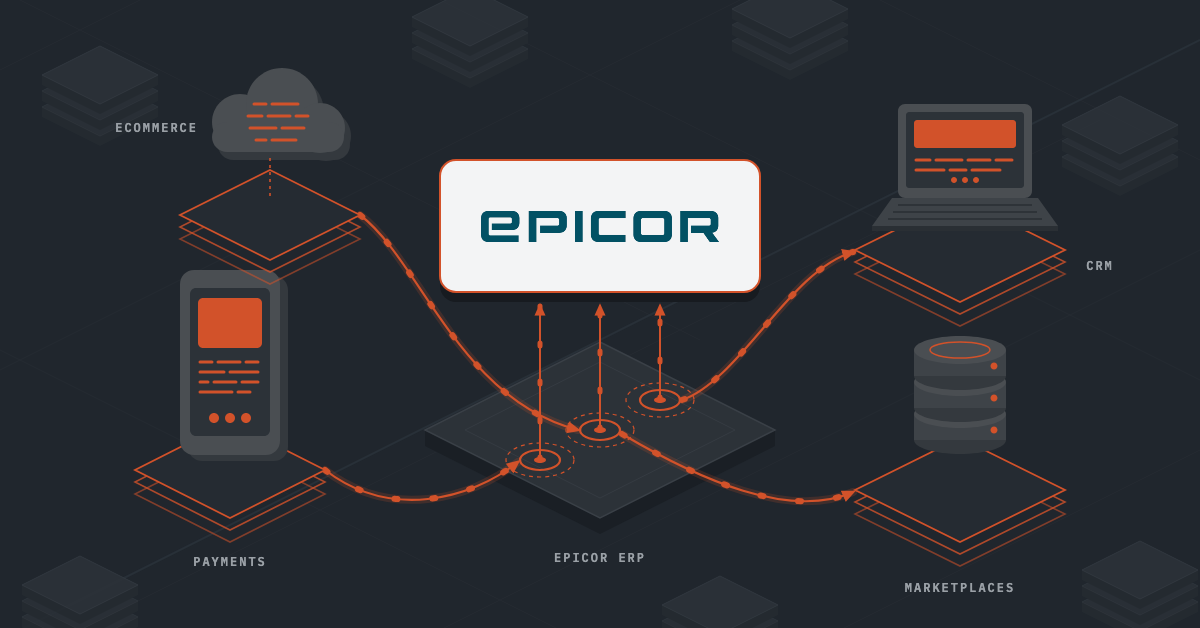
How a platform connects to your ecosystem dictates your long-term IT scalability. DCKAP Integrator offers an ERP-First approach. Rather than building individual, messy point-to-point connections between all your applications, it establishes your ERP (whether it is Epicor Prophet 21, Epicor Eclipse, Infor, or Sage) as the absolute central hub. All external software connects straight to that ERP pipeline. This simplifies data governance and ensures that the core business system remains the single source of truth.
Kore Integrate operates closer to the database engine level. It is optimized for scenarios where you need to extract and map data directly from the database tier. It features unique capabilities to read legacy MultiValue (NoSQL) databases (like Rocket UniData or UniVerse), which store data in flexible, nested arrays, and automatically flattens them into standard relational SQL structures. This allows companies to modernize their data capabilities without rewriting decades of underlying database code.
3. Daily Administration
Your choice should match the technical skillset of the team managing the software day-to-day. If your organization operates with a lean IT squad and prefers that ecommerce managers, logistics leads, or business analysts handle daily monitoring, DCKAP Integrator provides a lower barrier to entry. It utilizes a visual drag-and-drop flow designer and accessible Transaction Logging.
If your company maintains an internal team of database administrators, SQL developers, or IT specialists who require absolute, granular control over data dictionaries, schemas, and custom scripting, Kore Integrate gives them that environment. It focuses on technical flexibility, automatically generating Data Definition Language (DDL) and SQL Server Integration Services (SSIS) packages, allowing data engineers to build and control massive data migration pipelines.
4. Supply Chain Ecosystem Extensions
Distributors frequently need to extend their middleware beyond basic application connections to meet supply chain requirements. If your business acts as a tier-1 supplier to big-box retail networks like Home Depot, Amazon, or Walmart or major industrial buying groups, Electronic Data Interchange (EDI) compliance is non-negotiable. DCKAP Integrator addresses this by bundling built-in B2B EDI translation and integration directly into its platform, enabling you to manage EDI transactions through the exact same tool used for integration.
If your primary expansion goal is providing self-service tools for your existing customer base, Kore Technologies approaches this via its broader product ecosystem. Alongside Kore Integrate, they offer Kore Commerce, a specialized. NET B2B/B2C storefront solution that integrates with their middleware to automate complex post-sale processes like Return & Repair Administration (RRA).
Conclusion
Choosing the right tool comes down to your primary business goal. If you need a developer-focused tool built to handle massive data engineering, clean up older database formats, or build large corporate reporting warehouses, Kore Technologies is built for that heavy technical lifting. However, if you are looking to eliminate manual data entry, automate your daily sales workflows, and keep your website and ERP perfectly synchronized using a simple, low-code dashboard, DCKAP is the clear choice.
Get in touch with us at DCKAP today to chat with an integration engineer or book a free demo to see how we can connect your business.
FAQs
What is the difference between an ERP-First integration approach and an ETL data warehousing approach?
An ERP-First approach (used by DCKAP Integrator) establishes your central ERP as the single source of truth to ensure inventory, orders, and pricing remain synchronized across the business in real time while A data warehousing approach (used by Kore Integrate) extracts data from various internal systems to format, clean, and structure it into an external SQL Server database, prioritizing heavy historical analysis and reporting over live, operational application syncing.
What advanced features should B2B businesses look for in best-in-class solutions?
When evaluating best-in-class solutions, businesses look for advanced features that support long-term scalability. For distributors working with big-box retailers, having built-in B2B EDI translation is critical. Additionally, platforms that offer flexible data modifiers, reusable script snippets, and advanced scheduling help companies maintain clean data across multiple warehouses without needing to write custom code from scratch.
How does enterprise-grade security protect sensitive data during system synchronization?
Maintaining enterprise-grade security is a strict requirement for supply chain organizations connecting public ecommerce stores to backend financials. Secure integration platforms protect your data by utilizing encrypted communication tunnels, token authentication, and secure API keys. This ensures that proprietary wholesale pricing matrices and confidential customer transaction logs remain completely locked down as data flows between systems.
Can DCKAP Integrator handle legacy ERPs like Epicor Eclipse or Prophet 21?
Yes. B2B firms frequently look up if modern tools can talk to older, industry-specific systems. While DCKAP Integrator is a cloud-based platform, it features deep, specialized expertise and built-in native pipelines designed specifically for distribution systems like Epicor Eclipse, Prophet 21, and Infor, allowing you to link your backend to ecommerce without massive manual data mapping.
Why is Kore Integrate preferred for MultiValue NoSQL databases?
Database administrators often search for this when trying to clean older backend frameworks. Standard integration platforms are built to read relational databases (neat rows and tables) and fail when trying to read older, nested lists. Kore Integrate is uniquely engineered to read legacy MultiValue NoSQL database formats (like Rocket UniData or UniVerse) and translate them into clean, structured relational database formats automatically.
What are the operational benefits of an ERP integration for mid-market distribution firms?
For modern distribution firms, executing an automated ERP integration provides significant operational benefits by eliminating manual data entry and reducing fulfillment errors. Establishing your ERP as the core hub ensures that your inventory, contract pricing, and shipping information sync seamlessly during the integration process. By automating this workflow, your sales team is freed up from tracking down missing orders and can focus on proactive customer outreach.