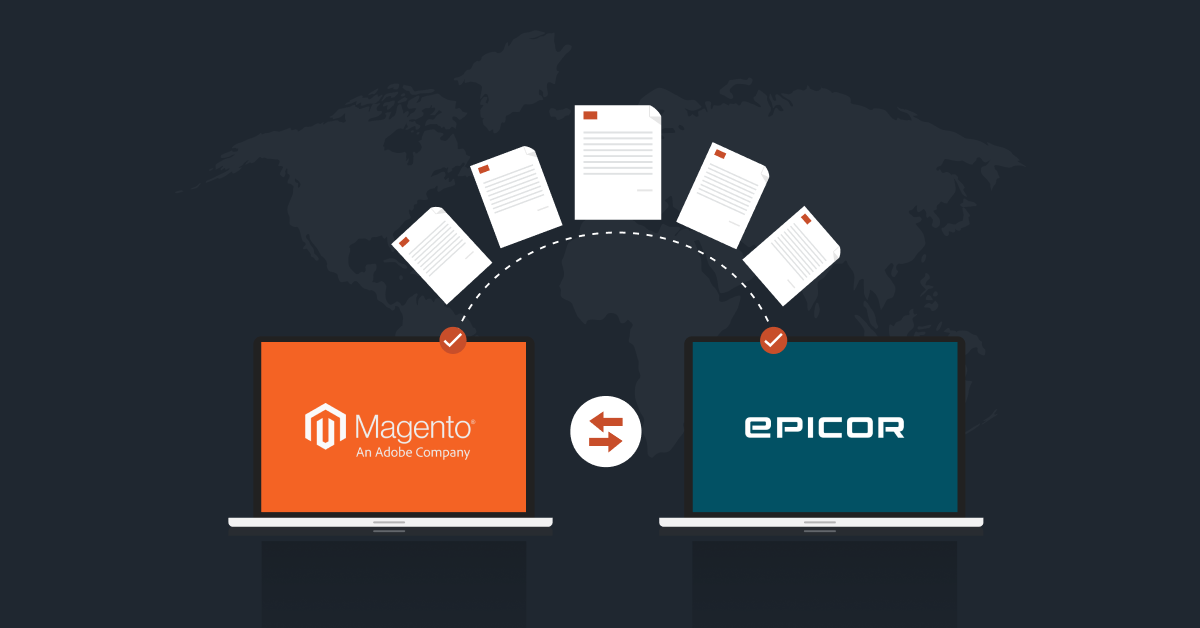
Magento Epicor Integration involves linking the Magento ecommerce platform (now Adobe Commerce) with the Epicor ERP system. This integration streamlines data flow between online storefronts and back-end operations, enhancing efficiency and accuracy. Businesses often integrate Magento with Epicor to optimize resource utilization, minimize manual data entry, and improve overall operational coherence in managing both the online and offline aspects of their business.
Methods of Magento Epicor Integration
Middleware Integration
This approach introduces a dedicated, cloud-based middle layer to act as a translator and a transmitter between Magento’s Web APIs (REST/GraphQL) and Epicor’s APIs. The middleware sits between both platforms. When an event occurs in Magento (e.g., a customer places an order), the middleware captures it, transforms the data structure to match Epicor’s database schemas, and safely pushes it into the ERP.
Pros:
- Pre-built Connectors: Many iPaaS platforms feature pre-configured workflows specifically built for standard B2B use cases between Adobe Commerce and Epicor.
- Complex Data Transformation: It excels at translating complex B2B logic, such as mapping Magento SKU formats to multi-variant Epicor part numbers.
- Robust Error Handling: If Epicor undergoes scheduled maintenance or goes offline, the middleware queues the incoming data and retries the sync automatically, preventing lost orders.
- Complete Tech Stack Freedom: It acts as a universal plug. You can easily add a Product Information Management (PIM) system, a CRM, or a new 3PL logistics provider later without ever messing with your core ERP setup.
Cons:
- Subscription Overhead: Requires ongoing licensing costs for the third-party middleware platform.
Native Integration via Epicor Commerce Connect (ECC)
Epicor Commerce Connect (ECC) is Epicor’s own ready-made connector tool. A critical point to know is that ECC is built exclusively for Magento and will not work with any other ecommerce platform like Shopify or BigCommerce. It uses Magento as the online store engine and links it directly to Epicor using pre-packaged synchronization rules.
For businesses fully committed to Magento, ECC is a highly popular and ideal choice. Because it is created by the ERP vendor, it cuts down on initial setup time and eliminates the need to design an integration framework completely from scratch.
Pros:
- Handles Complex B2B Logic Natively: It is fantastic at automatically syncing complex Epicor rules right out of the box, such as customer-specific contract pricing matrices, real-time credit limit checks, and multi-warehouse inventory levels.
- Faster Deployment: Since the data maps are pre-built, you don’t have to spend months figuring out how the two systems should talk to each other.
Cons:
- Zero Agility: It locks you completely into Magento. If your business ever decides to switch to a different online store platform in the future, the integration cannot move with you.
- Rigidity: If your business requires highly customized frontends or integrates multiple external systems (like a standalone PIM or complex 3PL), working within the strict architecture of ECC can become restrictive.
Direct Point-to-Point Integration
A Point-to-Point integration is a custom, direct bridge built by software developers. There is no middle software or platform involved; your developers write custom code that allows Magento to speak directly to Epicor’s connection points via timed schedules or real-time triggers.
Pros:
- No Middleware Fees: You save money on recurring monthly software subscription costs.
- Total Control: Your internal IT team has absolute governance over exactly how and when data moves between platforms.
Cons:
- High Risk of Breaking: If either Magento or Epicor pushes a routine software update or security patch, the custom bridge can instantly break, stopping all data flow until a developer manually codes a fix.
- Exhaustive Setup & Upkeep: The sheer amount of manual labor makes it incredibly resource-intensive and slow to deploy.
- Hidden Costs: Building comprehensive transaction logging and error-handling features from scratch is incredibly difficult and expensive.
| Note: While saving money on subscription fees sounds attractive upfront, P2P integrations are very brittle. They usually result in a tangled web of custom code that is expensive to maintain and slows down your business when you need to make changes. |
Enterprise Service Bus (ESB)
This is a heavy-duty setup designed for massive operations handling huge transaction volumes across multiple systems. Instead of sending data directly, Magento drops everyday events (like an order being placed) into a secure digital waiting line (a message queue). A separate background service then pulls these messages and feeds them into Epicor at a safe, steady pace.
However, it is crucial to understand that this method is primarily designed for legacy, on-premises systems. Born in the era of physical server rooms, ESBs are highly specialized for connecting old, local databases and are rarely chosen for modern, cloud-first integrations.
Pros:
- Total Independence: The two systems operate completely separately. Your online store can keep taking orders flawlessly even if your ERP is down for a weekend inventory count.
- Traffic Protection: It protects your ERP from crashing during peak morning hours when hundreds of commercial clients submit automated reorders at the same time.
Cons:
- Extreme Complexity: It is highly technical to design and requires specialized, expensive IT architects to manage.s on factors like scalability, efficiency, and the level of customization required for your Magento Epicor Integration.
Also read: Magento Systems Integrator Explained [+How to Pick the Right One]
Core Data Workflows to Sync Between Magento and Epicor
To achieve a seamless, automated workflow, several critical data points must be synchronized between Magento and your Epicor ERP, including:
1. Product Catalog & Master Data (Epicor → Magento)
This sync pulls core item information from your ERP and uses it to build or update product pages on your online store. For example, Part numbers (SKUs), descriptions, weights, dimensions, and Units of Measure.
Benefits:
- No More Double Data Entry: Instead of wasting hours manually typing thousands of technical product details into Magento, you manage everything in your Epicor ERP as the master database.
- Eliminates Errors: Updates made by your purchasing team in the ERP automatically flow to the website, ensuring customers always see accurate product specifications and shipping weights.
2. Inventory Levels & Warehouse Availability (Epicor → Magento)
This sync tells Magento exactly how many sellable units are available on hand across your warehouses. This includes real-time stock counts, multi-warehouse location quantities, and safety stock buffers.
Benefits:
- Prevents Mismatches and Overselling: If a local branch sells out of a product offline, the website needs to know immediately. Real-time sync protects you from selling a product online that is already promised to a different customer offline.
- Optimizes Stock Allocation: If you operate multiple distribution centers, this sync tells Magento which warehouse is closest to the customer, saving you money on freight and shipping times.
3. Customer-Specific Contract Pricing (Epicor → Magento)
It dynamically pulls negotiated contract rates directly from your ERP price matrices. Mainly includes tiered pricing, quantity breaks, promotional discounts, and client-specific contract price sheets.
Benefits:
- Personalized Buying Experiences: Unlike retail, B2B buyers do not shop at MSRP. By linking your ERP’s pricing database to Magento, returning buyers see *their* specific negotiated rates the moment they log in.
- Protects Profit Margins: It ensures you are always charging the correct, up-to-date pricing without your sales team having to manually double-check and adjust orders after the purchase is made.
4. Credit Terms, Limits, & Accounts (Bi-directional)
This sync links customer billing profiles, buying groups, and payment allowances between the online store and the back office. Documents to sync in this case would be company billing and shipping addresses, tax-exempt certificates, credit limits, and payment terms (such as Net 30/60/90).
Benefits:
- Automates the Checkout Process: Many corporate buyers checkout using a Purchase Order (PO) number. This sync pings the ERP to verify if the buyer’s credit limit is active and has enough balance before allowing the checkout to complete.
- Saves Customer Service Time: New customer accounts registered on Magento flow directly into the ERP, complete with tax-exemption statuses, removing the need for manual customer onboarding.
5. Sales Orders & Checkout Data (Magento → Epicor)
The moment a customer submits an order online, this sync transfers the complete checkout details including ordered items, quantities, shipping methods, customer PO numbers, tax calculations, and online payment details directly into your ERP for fulfillment.
Benefits:
- Drastically Cuts Fulfillment Times: Instead of having an employee manually re-type website orders into your ERP, orders instantly populate as active sales orders ready for your warehouse team to pick, pack, and ship.
- Operational Peace of Mind: By utilizing a middleware system with robust transaction logging, your team has a clear record of every transfer, making it easy to confirm that order data arrived safely and without errors.
6. Shipping Statuses & Tracking (Epicor ERP → Magento)
Once an order is physically packed and shipped, the shipping details like carrier tracking numbers, shipping methods (such as FedEx, UPS, LTL freight), and invoice PDFs are pushed back to Magento.
Benefits:
- Enables Customer Self-Service:The moment your ERP marks an order as shipped, Magento automatically sends an email update to the customer with their tracking link.
- Decreases Support Tickets: Giving B2B buyers direct, instant access to their shipment statuses cuts down on “Where is my order?” calls, allowing your customer support team to focus on higher-value tasks.
Also read: Magento PIM Integration: Why & How Explained
Technical Challenges & Solutions for Connecting Magento to Epicor
Below are the five most common challenges that users generally face:
Data Mismatch
Magento and Epicor store product data differently. Without proper mapping, products, quantities, and orders can become inaccurate.
Common issues:
- Product variants (size, colour) don’t sync correctly.
- Unit of Measure (UOM) mismatches, such as “Box” vs. “Each.”
- Different field formats cause sync failures.
Solution:
- Create a data mapping layer between Magento and Epicor.
- Map products and UOMs before syncing.
Slow Performance
Real-time API calls for pricing, inventory, and customer data can slow down your website, especially during high traffic.
Common issues:
- Slow page loading.
- API rate limits or throttling.
- Poor shopping experience.
Solution:
- Cache frequently used data like product catalogues and pricing.
- Use real-time API calls only during checkout or when necessary.
Downtime and Connectivity Issues
If Epicor is unavailable due to maintenance or network issues, orders may fail to sync.
Common issues:
- Failed or delayed orders.
- Checkout interruptions.
- Manual order recovery.
Solution:
- Use middleware with queue management.
- Automatically sync pending orders once Epicor is back online.
Custom Epicor Workflows
Many businesses customize Epicor with unique pricing rules, fields, and workflows that standard connectors cannot handle.
Common issues:
- Connector limitations.
- Broken integrations after upgrades.
- Custom fields not syncing.
Solution:
- Document all custom workflows before integration.
- Use flexible middleware that supports custom business logic.
Lack of Monitoring
Integration failures often happen silently, causing delayed orders and unhappy customers.
Common issues:
- Orders getting stuck without anyone noticing.
- Time-consuming manual troubleshooting.
- Delayed fulfilment.
Solution:
- Enable transaction logging and monitoring.
- Set up automatic email or SMS alerts for failed syncs.
- Use dashboards to quickly identify and resolve issues.
How Magento Epicor Integration Helps
Here are the major operational benefits of integrating Magento ecommerce platform and Epicor ERP:
Workflow Automation
By integrating Magento with Epicor software, you access the power of streamlined workflows. Automation eliminates the hassle of manual tasks, ensuring processes run seamlessly. This efficiency not only saves much time but also enhances overall productivity, allowing your team to focus on strategic aspects of your business.
Customer Management
Simplify the often tedious task of managing customer data. The integration seamlessly syncs customer information such as customer accounts, complete account history, customer billing details between Magento and Epicor, automating updates when customers fill out profiles on either platform. This eliminates the manual effort required for data entry, especially beneficial for larger companies. Additionally providing an unparalleled experience to the customer base.
Product Management
With Magento Epicor Integration, maintaining product records becomes effortless. The tight integrations bring your ERP system and online store together, facilitating seamless synchronization of product information. Manual syncing is a thing of the past, ensuring accurate and up-to-date product details and significantly improving overall product management efficiency.
Order Management
Provide assurance to your customers and maintain a detailed order history effortlessly with Magento Epicor Integration. The synchronized order details on both platforms offer real-time visibility. This transparency not only meets customer expectations but also aids business owners in making efficient deliveries and providing timely after-sales services.
Pricing Management
Manage crucial functions like shipment, customer returns, and taxation seamlessly. Calculate rates effortlessly on product listing pages and details, offering buyers a seamless checkout experience. This integration simplifies pricing information management, providing a hassle-free and reliable transaction process for your customers.
Also read: Magento ERP Integration Explained [+Case Studies]
Top Tools to Integrate Epicor and Magento
1. DCKAP Integrator
DCKAP Integrator is an ERP-first integration platform built specifically for manufacturers and distributors using Magento and Epicor ERP.
Unlike traditional integration tools that treat every application equally, DCKAP Integrator keeps Epicor at the center of your technology ecosystem, ensuring your ERP remains the single source of truth for products, inventory, pricing, customers, and orders.
With pre-built connectors, low-code workflows, and real-time data synchronization, businesses can automate critical processes, reduce manual effort, and build integrations that are easier to scale and maintain.
Features and Benefits
- Pre-built Magento and Epicor connectors for faster implementation
- Real-time and scheduled data synchronization
- Low-code integration builder for faster customization
- Flexible data mapping and transformation to match business workflows
- Centralized transaction logging for complete visibility into every sync
- Real-time error monitoring and alerts for quick issue resolution
- Scalable cloud-based platform that grows with your business
- Support for custom APIs and third-party applications
- Reliable, enterprise-grade integrations with ongoing support and maintenance
Cons
- Limited library of pre-built connectors.
2. Jitterbit
Jitterbit emerges as one of the top choices for Magento Epicor Integration, offering a streamlined solution for efficient data management. With Jitterbit one can easily automate the intricate data exchange between Magento and Epicor effortlessly.
Real-time inventory updates across your online platform, physical stores, and warehouse become a breeze, ensuring your customers receive accurate information at all times. The automation of shipping details from Magento to Epicor upon order fulfillment enhances order processing efficiency.
Features and Benefits
- Reduction of transactional errors by a substantial percentage
- Speeds up your order-to-cash cycle time
- Workflow automation
Cons
- Costlier solution for smaller businesses
- Complex onboarding
3. MuleSoft
MuleSoft seamlessly integrates Magento and Epicor by leveraging its advanced integration capabilities. Through dedicated connectors for both Magento and Epicor, MuleSoft facilitates the smooth exchange of data between these platforms.
The Anypoint Platform enables efficient mapping and transformation of data, ensuring compatibility between the systems. Real-time synchronization is established, encompassing vital information such as product details, inventory levels, customer data, and orders.
Features and Benefits
- Event-driven architecture for dynamic integration
- Robust error handling ensures reliable processes
- Scalable solution for growing business needs
- User-friendly interface for seamless operations
Cons
- Steeper learning curve for beginners.
- Relatively expensive, especially for small businesses.
- Requires dedicated resources for implementation and maintenance.
- Complex integrations may take longer to deploy.
4. Celigo
Celigo’s integrator.io emerges as a top-tier solution for Magento Epicor Integration, offering a complete iPaaS that streamlines key business processes at scale.
The Celigo Platform provides a wealth of managed, prebuilt solutions enriched with best practices, AI, and machine learning. This comprehensive library facilitates a streamlined integration process. Notably, Celigo ensures accessibility for everyone, offering an approachable user experience for business users to confidently create and manage automations aligned with their evolving ecommerce business processes.
Features and Benefits
- Incorporates pre-built automation and best practices for efficient integration.
- wide range of pre-built connectors
- Modern and intuitive UI
- Responsive and supportive customer service
Cons
- Complex cost structure
- Learning curve
- Dependency on third-party connectors for integration
5. Integrate.io
Integrate.io stands out as a top-tier option for Magento Epicor Integration, presenting a low-code solution that simplifies the complexities associated with custom connectors.
The platform’s prowess lies in its prebuilt APIs, which seamlessly facilitate the connection between Magento and an extensive array of popular tools. Users can effortlessly collect specific data by selecting endpoints, and the intuitive backend enhances the configuration of ETL pipelines for a smoother integration process.
Features and Benefits
- Setting up a Magento connection is quick and efficient.
- Leverages the Magento Web API for enhanced connectivity.
- Tailored for compatibility with Epicor systems.
- Facilitates a smooth authentication process for secure integration.
Cons
- limitations on customization possibilities for the integration procedure.
Also read: Magento CRM Integration: What You Need To Know
Future-Proof Your Magento Epicor Integration with DCKAP Integrator
As your business grows, your integration needs will evolve too. DCKAP Integrator is designed to support that growth by providing a scalable integration platform that adapts to new applications, changing workflows, and increasing transaction volumes without adding unnecessary complexity.
For distributors and manufacturers looking for a long-term Magento Epicor integration solution, DCKAP Integrator offers the flexibility, reliability, and industry expertise needed to build a connected digital ecosystem.
Want to see if DCKAP Integrator is the right fit for your business? Contact our team for a personalized consultation or explore our pricing plans to get started.
FAQS
What is eCommerce and ERP Integration?
eCommerce and ERP integration is the process of connecting an ecommerce platform (such as Magento, Shopify, or WooCommerce) with an Enterprise Resource Planning (ERP) system. This integration allows seamless data exchange between these systems, improving overall business efficiency.
What is Epicor Magento Integration?
Epicor Magento Integration refers to the process of connecting the Epicor enterprise resource planning (ERP) system with the Magento ecommerce platform. This integration facilitates seamless data flow between the two systems, optimizing complex business operations.
Why is Magento Epicor Integration important?
Integration between Magento and Epicor enhances operational efficiency by automating tasks such as supply chain management, inventory management, and customer relationship management. This Integration is designed to enhance the performance and speed of your ecommerce technology platform, resulting in faster and more accurate order fulfillment, reducing the likelihood of errors and improving customer service.
What data can be synchronized between Magento and Epicor?
The integration typically allows the synchronization of various data, including rich product information, customer data, sales orders, inventory levels, customer-specific pricing, and shipping details. This ensures consistency and accuracy across both platforms.
How does Magento Epicor Integration contribute to an innovative digital commerce solution?
Integration brings innovation to your digital commerce by seamlessly connecting the innovative features of Magento with the robust capabilities of Epicor, creating a single source of truth and an advanced platform for your ecommerce operations.
Is Epicor Magento Integration scalable for businesses of different sizes?
Yes, Epicor Magento Integration is scalable and can be tailored to meet the needs of businesses of varying sizes. Whether you are a small business or a large enterprise, the integration can be customized to fit your specific requirements.
Can I get support for version-specific integration issues with Epicor and Magento?
Yes, professional support is often available for version-specific integration issues. Business intelligence can rely on their integration provider for assistance in addressing any challenges related to integrating Magento with specific versions of Epicor, such as Epicor Prophet 21, Epicor Eclipse, or ERP 10.
How does opting for a managed service in Magento Epicor Integration benefit my business?
A managed service provides ongoing support, maintenance, and updates for the integration. This ensures that your integration remains robust, secure, and up-to-date, allowing you to focus on your core business while experts manage the technical aspects.