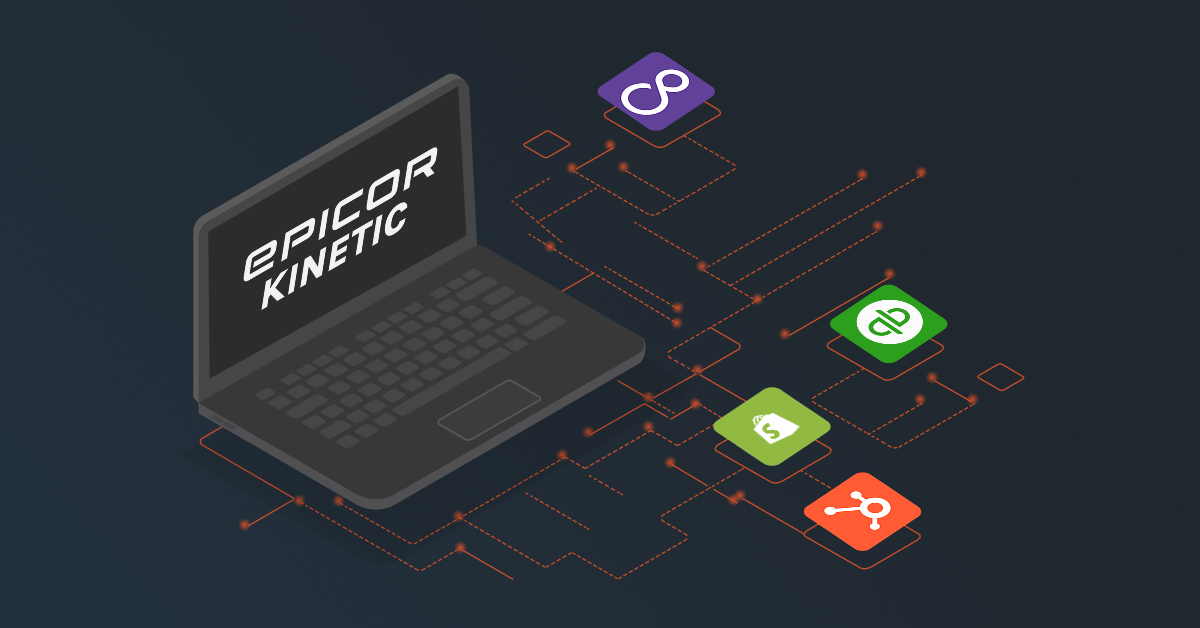
Epicor Kinetic may be at the center of your operations, but it’s probably not the only system your teams use. Your ecommerce store, CRM, warehouse, EDI, payments, and other tools still need to share data with your ERP.
In this guide, we’ll look at common Epicor Kinetic integration examples, the data you can exchange, and the best ways to connect these software.
Common Epicor Kinetic Third-Party Integration Examples
If Epicor Kinetic is your ERP, you may still have several other systems handling different parts of your business. Here are some of the common ways businesses connect Kinetic with those systems.
Epicor Kinetic + eCommerce
If you sell online through Shopify, BigCommerce, Adobe Commerce, or another ecommerce platform, you can connect it with Epicor Kinetic so your store and ERP can share the information they need. Product details, pricing, inventory, customer information, and orders can move between the two systems. For example, when a client places an order on Shopify, that order can flow into Kinetic for processing, while inventory and fulfillment updates can move back to the store.
Epicor Kinetic + CRM (Customer Relationship Management)
Your sales team may work primarily in a CRM such as Salesforce or HubSpot, while your operational and order information sits in Kinetic. Connecting the two gives sales teams access to the ERP information they need without having to keep checking two separate systems. Customer details, quotes, orders, products, and other relevant information can be exchanged between the CRM and Kinetic.
Epicor Kinetic + EDI (Electronic Data Interchange)
For manufacturers and distributors working with retailers, suppliers, and other trading partners, EDI is another common connection. A purchase order received from a trading partner can move through EDI into Epicor Kinetic ERP, and documents such as order acknowledgments, advance shipping notices, and invoices can flow back to the partner. This keeps the trading process connected without requiring teams to stick to manual processes.
Epicor Kinetic + WMS (Warehouse Management System)
If you use a separate warehouse management system, connecting it with Kinetic can keep your ERP and warehouse operations in sync. An order created in Kinetic can be sent to the WMS for picking and packing, and once the order is shipped, the fulfillment and shipment information can be sent back to Kinetic. Inventory updates can also move between the two systems so teams have a more consistent view of what is available.
Epicor Kinetic + Payment Systems
If clients pay through an online payment platform, you can connect that system with Kinetic so payment information can move along with the order. A customer might place an order online, complete the payment, and have the payment status passed along for the order to be processed in Kinetic. Depending on the setup, refunds and other payment-related information can also be exchanged.
Epicor Kinetic + Marketplaces
Selling through Amazon, Walmart, eBay, or other marketplaces creates another place where your product, inventory, and order information needs to stay updated. An integration can bring marketplace orders into Kinetic for processing and send inventory, fulfillment, and tracking updates back to the marketplace. This becomes especially useful when you sell across multiple channels and don’t want teams updating each one manually.
Epicor Kinetic + Shipping and Logistics Systems
Shipping platforms, transportation management systems, carriers, and 3PLs can also be connected with Kinetic. Once an order is ready to ship, the relevant order and shipping information can move from Kinetic to the logistics system. The tracking number and shipment status can then come back to Kinetic and, if needed, be passed on to the customer’s ecommerce or other customer-facing system.
Epicor Kinetic + Accounting and Finance Systems
Some organizations use separate accounting or financial applications alongside their ERP systems. In those cases, connecting the other systems can help keep invoices, payments, customers, and other financial information aligned. For instance, an invoice created in Kinetic can be passed to the accounting system, while payment information can flow back to keep records up to date.
Epicor Kinetic + PIM (Product Information Management)
If you manage a large product catalog, you may also use a product information management system alongside Kinetic. Product descriptions, attributes, specifications, and other information can be exchanged between the ERP and PIM, depending on which system owns each piece of data. The PIM can then help distribute that product information to your ecommerce store, marketplaces, or other sales channels.
Epicor Kinetic + Other Business Applications
And these aren’t the only options. Epicor ERP can also be connected with customer portals, supplier systems, reporting and analytics platforms, service applications, data warehouses, and custom-built applications. The integration really depends on what systems you already have and where you need information to move.
Also read: Epicor Kinetic EDI Integration: All You Need to Know
What Data Can Be Exchanged With Epicor Kinetic?
The data you exchange with Epicor Kinetic depends on the systems you are connecting and how you want them to work together. In most cases, though, the integration revolves around a few common types of business data.
- Product data can include SKUs, product names, descriptions, specifications, categories, pricing, and other product information. This is especially useful when Kinetic is connected to an ecommerce platform, marketplace, or PIM.
- Inventory data can move between Kinetic and systems such as ecommerce platforms, marketplaces, and WMSs. Available inventory, stock levels, warehouse information, and inventory updates can be shared so that other systems have a more accurate view of what is available.
- Customer data can include customer accounts, contact information, addresses, and other relevant information. For example, a CRM or ecommerce platform can exchange customer information with Kinetic so teams don’t have to maintain the same records separately.
- Order data is another major part of most integrations. Orders created in an ecommerce store, marketplace, CRM, or through EDI can be sent to Kinetic for processing. Order status, fulfillment details, and other updates can then move back to the system where the order originated.
- Purchase orders and EDI documents can also be exchanged with trading partners and supplier systems. Depending on the workflow, this may include purchase orders, acknowledgments, order changes, advance shipping notices, and invoices.
- Shipping and fulfillment data can move between Kinetic and WMS, TMS, 3PL, or shipping systems. This can include shipment details, tracking numbers, carrier information, and order status updates.
- Invoice and payment data can also be exchanged when Kinetic is connected with accounting, payment, or other financial systems. This can help keep invoice and payment records aligned across applications.
The important part is that you don’t necessarily need to move every piece of data between every system. The right integration starts by deciding which system owns each type of data and what information the other systems actually need.
How to Integrate Epicor Kinetic With Third-Party Systems
There are several ways to connect Epicor Kinetic with third-party systems. The right approach depends on the systems involved, your technical resources, and how much of the integration you want to manage yourself.
1. Direct API Integration
Direct API integration connects Epicor Kinetic directly with another application through APIs. Your internal IT or development team typically builds, tests, monitors, and maintains the connection.
Best suited for: Businesses with in-house developers, a small number of integrations, and a need for direct control.
Internal resources: High. Your team is responsible for development and ongoing maintenance.
2. EDI Integration
EDI is used to exchange standardized business documents with trading partners. An EDI provider can handle translation, mapping, partner onboarding, and ongoing EDI management.
Best suited for: Manufacturers and distributors exchanging orders, invoices, ASNs, and other documents with trading partners.
Internal resources: Low with a full-service EDI provider, but potentially high with a standalone EDI translator or web EDI solutions. For a more hands-free approach, a managed solution such as DCKAP EDI is worth considering.
3. FTP/SFTP or File-Based Integration
This approach exchanges files such as CSV or XML through FTP/SFTP, usually on a scheduled basis. It can be managed internally or by an integration vendor.
Best suited for: Legacy systems, applications without suitable APIs, and batch-based workflows.
Internal resources: Moderate when managed internally; lower when a vendor handles the integration.
4. Custom Integration
Custom integrations are built around specific systems or business requirements and can use APIs, files, or other methods.
Best suited for: Custom applications, complex workflows, or systems that don’t fit a standard integration approach.
Internal resources: Moderate to high if built internally. A vendor can handle development and maintenance if you don’t have the required expertise.
5. Middleware or Managed Integration Platform
A middleware or managed integration platform sits between Kinetic and your third-party systems. It can use APIs, EDI, FTP/SFTP, or other methods while handling data mapping, monitoring, errors, and ongoing maintenance.
Best suited for: Businesses connecting multiple systems or those that don’t want to manage integrations in-house.
Internal resources: Low. Your team typically provides access, requirements, and testing input while the integration provider manages the technical work.
Also read: Epicor Kinetic CRM Integration: What You Need To Know
Best Way to Integrate Epicor Kinetic With Third-Party Systems
If Epicor Kinetic is already the backbone of your business, your integration approach should work around it, not make it another system to manage. DCKAP Integrator takes an ERP-first approach, keeping Epicor Kinetic at the center while connecting the rest of your tech stack around it.
Whether you need to connect Kinetic with ecommerce, CRM, WMS, EDI, marketplaces, payment systems, or other applications, DCKAP Integrator manages the data flow between these systems. This helps keep Kinetic as the source of truth while each connected system gets the information it needs.
A fully managed integration
You don’t need to build and maintain these integrations yourself. The DCKAP team handles the process from onboarding and implementation to mapping, testing, monitoring, troubleshooting, and post-integration maintenance.
That means your internal team can provide the necessary system access and business requirements without having to take on the day-to-day work of keeping integrations running.
Flexible integration options
DCKAP Integrator can work with different integration methods, including APIs, EDI, FTP/SFTP, and other supported interfaces. This makes it possible to connect both modern cloud applications and systems that rely on older or file-based methods.
You also get visibility into your integrations through monitoring, logs, alerts, and error handling, so issues can be identified and addressed without manually checking every system.
Cost-effective as your integrations grow
Instead of investing in a separate team to build and maintain multiple point-to-point integrations, you can have one managed platform and integration team supporting your connections. DCKAP’s flat-fee pricing also makes costs more predictable as you add systems and workflows.
So, if you’re using Epicor Kinetic and want a simpler way to connect the rest of your business applications, schedule a chat with our integration experts.
FAQs
What can you integrate with Epicor Kinetic?
You can connect Epicor Kinetic with external systems such as ecommerce platforms, CRM software, WMS, EDI, marketplaces, payment systems, shipping tools, and business intelligence platforms. Kinetic’s REST API provides access to ERP services, data, and business logic, making it possible to connect the ERP platform with different business systems.
What is the difference between Epicor Automation Studio and a third-party integration platform?
Epicor Automation Studio is Epicor’s low-code integration and automation platform, powered by Workato. It is designed to connect Epicor applications with external apps and automate business processes with APIs, connectors, recipes, and AI-assisted tools. A third-party managed integration platform may offer a different approach, particularly when a business wants a vendor to handle implementation, maintenance, monitoring, and support.
What should Epicor users consider before integrating a third-party system?
Start with the business process rather than the technology. Identify which system owns the data, what information needs to move, whether it needs to be real-time, how errors will be handled, and who will maintain the integration. These best practices help create integrations that support the business instead of adding another system for users to manage.
How does EDI reduce manual data entry and human error?
Without EDI, employees may have to manually enter information from emails, PDFs, or other documents into an Epicor ERP system. This takes time and creates opportunities for duplicate entries or incorrect data.
With EDI, standardized documents can move directly between trading partners and connected business systems. This reduces manual data entry, minimizes repetitive work, and helps improve data accuracy and operational efficiency.
Can Epicor Kinetic integrations support manufacturing and supply chain processes?
Yes. Integrations can connect Kinetic with systems used across manufacturing and supply chain management, including WMS, ecommerce, EDI, TMS, 3PL, supplier systems, and other applications.