A customer sees a product, checks its price, sees whether it’s in stock, and places an order. Behind that simple storefront experience, several pieces of data need to line up with what’s happening in Epicor Kinetic.
Product details, inventory, customer information, pricing, orders, and fulfillment data may all need to move between the two systems. So, what does an Epicor Kinetic ecommerce integration actually involve? Let’s break it down.
Methods of Integrating Epicor Kinetic With eCommerce
Organizations can connect Epicor Kinetic with ecommerce platforms in several ways. The right approach depends on the level of customization required, the systems involved, the volume of data, and whether data needs to move in real time or on a schedule.
1. Native Connectors
Epicor provides several tools that can be used to connect Kinetic with ecommerce and other business systems.
- Epicor Commerce Connect (ECC) is designed specifically to connect Epicor ERP with ecommerce operations. It can support workflows such as customer-specific catalogs, pricing, inventory availability, orders, quotes, and other B2B commerce requirements.
- Epicor Integration Cloud (EIC) and Epicor Automation Studio provide integration capabilities for connecting Kinetic with other applications and workflows. These can be used to move data between Kinetic and ecommerce platforms while handling tasks such as data mapping and workflow automation.
- Epicor Service Connect (ESC) is another Epicor integration and workflow tool. It can help automate system-to-system workflows, transform data, and connect Kinetic with external applications.
Best for: Companies that want to use Epicor’s own ecosystem of tools and capabilities to build and manage their integrations.
2. Direct REST API Integration
Epicor Kinetic provides REST APIs that allow external applications to communicate directly with the ERP.
With this approach, developers can build a connection between Kinetic and an ecommerce platform and determine exactly what data should move between the systems. Developers can also use Epicor business objects, BAQs, and Epicor Functions to support more customized integration requirements.
Best for: Businesses with development resources that need highly customized integration logic and have the technical capability to build and maintain the connection.
3. File-Based and SFTP Integration
With file-based integration, data can be exported from one system as a CSV, XML, or JSON file, transferred through FTP/SFTP, and then imported into the other system.
This approach can work well for batch-based processes, such as bulk catalog updates or scheduled order processing, where immediate synchronization isn’t necessary.
Best for: Businesses working with legacy systems, large batch transfers, or workflows where scheduled synchronization is sufficient.
4. Third-Party Middleware
Instead of building the entire integration from scratch, businesses can use a third-party integration platform or managed middleware.
An integration platform sits between Epicor Kinetic and the ecommerce platform and manages the movement of data between them. The integration vendor can also manage customizations based on your specific business requirements. For example, if your business has customer-specific pricing, multiple warehouses, unique inventory rules, or a customized order workflow, these requirements can be handled as part of the integration.
Another advantage is that managed middleware doesn’t necessarily limit you to one integration method. The same provider can support REST API, SFTP, file-based, and other integration methods depending on what each system supports.
Best for: Businesses that want a more hands-off integration approach, have limited internal technical resources, or need ongoing customization and maintenance without managing the integration themselves.
Also read: Epicor Kinetic EDI Integration: All You Need to Know
What Data Can Be Synced Between Epicor Kinetic and eCommerce?
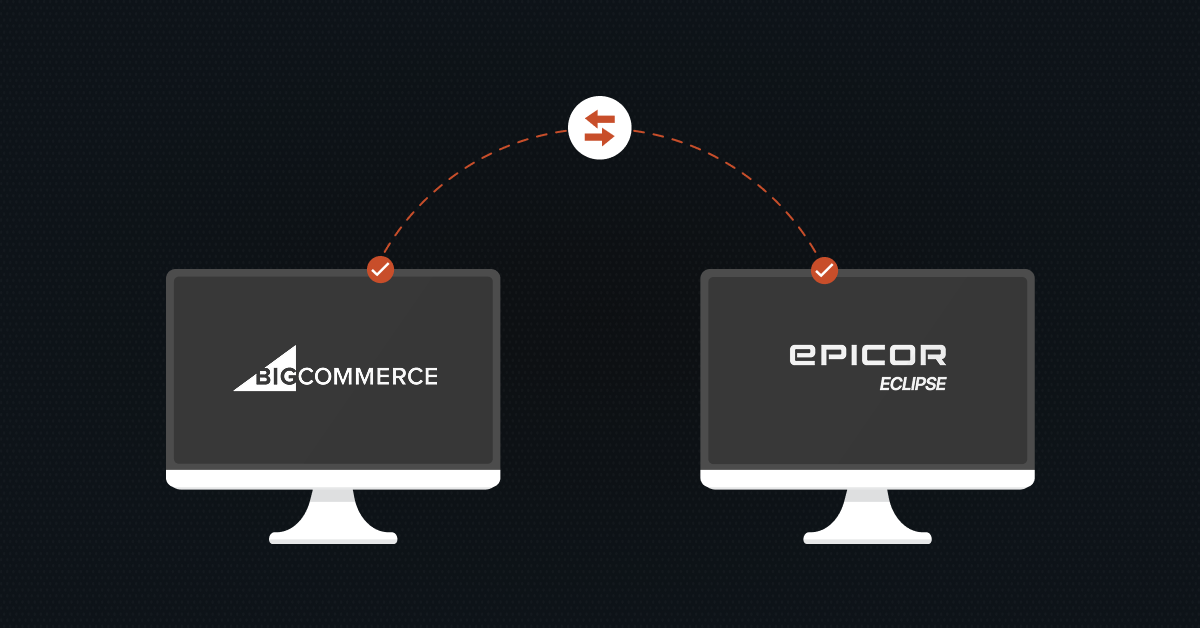
An Epicor Kinetic integration with ecommerce creates a two-way flow of data between the online store and Kinetic, helping businesses keep product, customer, pricing, inventory, and order information in sync.
Whether the storefront is Shopify, BigCommerce, Adobe Commerce, or a custom B2B portal, the exact data flow depends on the business requirements and integration setup.
Here are the key types of data that can be synchronized.
1. Product and Catalog Data
Flow direction: Epicor Kinetic → eCommerce
Product information maintained in Epicor Kinetic can be sent to the ecommerce platform, reducing the need to maintain the same information in multiple systems. This can include:
- SKU and product numbers
- Product names and descriptions
- Product categories
- Product attributes and specifications
- Units of measure (UOM)
- Product images
- Product status
- Brand or manufacturer information
- Product availability
For businesses with large product catalogs, automated product synchronization can also make it easier to keep storefront information updated as products are added, changed, or discontinued.
2. Customer Accounts and B2B Data
Flow direction: Bidirectional
Customer information can move between the storefront and Epicor Kinetic, depending on the business workflow.
eCommerce → Kinetic:
- New customer registrations
- Contact information
- Billing and shipping addresses
- Customer profile updates
- Online account information
Kinetic → eCommerce:
- Customer IDs
- Customer groups
- Payment terms
- Credit information
- Tax-related information
- Sales representative assignments
- Account-specific settings
This is particularly useful for B2B ecommerce, where customers may have different account rules, payment terms, or purchasing permissions.
3. Pricing and Customer-Specific Pricing
Flow direction: Epicor Kinetic → eCommerce
B2B customers often don’t all pay the same price for the same product. Pricing information from the ERP system can be synchronized with the storefront so customers see the pricing that applies to their account.
This can include:
- Standard pricing
- Tiered pricing
- Quantity-based pricing
- Customer-specific pricing
- Contract pricing
- Promotional pricing
- Price lists
- UOM-based pricing
- Customer-specific catalogs
This helps prevent sales teams from having to manually update or maintain pricing in both the ERP and ecommerce platform.
4. Inventory and Product Availability
Flow direction: Epicor Kinetic → eCommerce
Inventory synchronization helps the storefront reflect what is actually available for sale.
Depending on the integration, businesses can sync:
- On-hand inventory
- Available inventory
- Allocated or reserved quantities
- Warehouse-level inventory
- Multi-location inventory
- Available-to-promise (ATP)
- Backorder information
- Estimated availability or lead times
For example, instead of simply showing the total quantity sitting in the ERP, the integration can use the business’s inventory rules to determine what quantity should actually be shown as available online.
5. Sales Orders, Quotes and RFQs
Flow direction: eCommerce → Epicor Kinetic
When a customer places an order online, the integration can automatically send the order information to Kinetic for processing. This can include:
- Customer details
- Order number
- SKUs and quantities
- Pricing
- Discounts
- Shipping information
- Taxes
- Purchase order numbers
- Payment/order information
- Product configuration details
For B2B businesses, the integration can also support quote requests and RFQs, allowing online requests to enter the appropriate Kinetic workflow for review and conversion into an order.
6. Order Status, Fulfillment and Tracking
Flow direction: Epicor Kinetic → eCommerce
The integration doesn’t have to stop once an order reaches Kinetic. Updates from the ERP can flow back to the storefront so customers can track what is happening with their orders. This can include:
Order confirmation
- Processing status
- Partial shipment status
- Shipment dates
- Carrier information
- Tracking numbers
- Delivery status
- Backorder updates
This gives customers better visibility without requiring them to contact the sales or customer service team for every order update.
7. Invoices, Payments and Credits
Flow direction: Epicor Kinetic → eCommerce
For B2B customer portals, businesses can also make financial information available through the ecommerce platform. Depending on the workflow, this may include:
- Invoice information
- Invoice status
- Payment status
- Payment terms
- Credit memos
- Outstanding balances
- Payment confirmations
This can turn the ecommerce platform into more than a place to place orders. It can become a self-service portal for existing customers.
8. Returns and Credit Information
Flow direction: Bidirectional
Returns can also be part of the integration, depending on how the business manages its return process. Data may include:
- Return requests
- Return authorization
- Returned products
- Return status
- Credit information
- Refund status
This keeps the customer-facing side and the ERP aligned as a return moves through the process.
Also read: Epicor Kinetic Third-Party Integration Examples: eCommerce, CRM, EDI, WMS, Payment & More
What Impact Does Epicor Kinetic eCommerce Integration Have on Business Operations?
Connecting Epicor Kinetic with an ecommerce platform does more than move data between two systems. It changes how teams manage orders, inventory levels, customers, and pricing by reducing the amount of manual work involved in keeping both systems updated.
Here are some of the operational changes businesses can see:
Less Manual Data Entry
Without an integration, teams may need to move information manually between the ecommerce platform and ERP. This can mean entering online orders, updating customer records, checking inventory, or maintaining pricing in multiple places. With automated sync, much of this work can happen in the background.
Fewer Data Errors
Manual data entry creates opportunities for errors in SKUs, quantities, customer information, pricing, and shipping details. Automated data sync reduces the number of times teams have to manually copy the same information between systems. This can help keep the ERP and storefront aligned and reduce issues caused by outdated or incorrectly entered data.
Better Inventory Visibility
When inventory information is regularly synchronized between Kinetic and ecommerce, customers and internal teams can work with more consistent availability information. The result is fewer situations where the storefront shows information that doesn’t match what’s available in the ERP.
Faster Order Processing
An integrated workflow can move an online order into Epicor Kinetic automatically. That can reduce manual handoffs and give operations teams more time to focus on exceptions and other work.
More Consistent B2B Pricing
For distributors and manufacturers, pricing can get complicated quickly. Different customers may have different contracts, price lists, quantity breaks, or negotiated rates. Synchronizing pricing from Kinetic to ecommerce means customers can see the pricing associated with their account rather than relying on a separate manual process.
Better Customer Self-Service
Customers can get access to more information directly through the ecommerce platform, such as product availability, customer-specific pricing, order status, invoices, and account information. This can reduce the need for customers to call or email the sales or customer service team for routine updates.
Fewer Operational Bottlenecks
When teams rely on manual processes, one person or department can become a bottleneck for updating information. Automated synchronization moves data between systems without requiring someone to trigger every step manually. This can help sales, customer service, warehouse, and operations teams work from the same information.
Better Visibility Across Teams
When ecommerce and ERP data stays synchronized, teams don’t have to rely on separate spreadsheets, emails, or software checks to understand what’s happening. Sales can see order information. Customer service can access order and shipment updates. Operations can work from ERP data. Customers can access relevant information through the storefront.
Easier to Scale
As the number of products, customers, orders, and online sales channels grows, manual processes become harder to maintain. An automated integration provides a foundation for handling higher transaction volumes without increasing manual data-entry work at the same rate.
Common Challenges in Epicor Kinetic eCommerce Integration and How to Solve Them
Connecting Epicor Kinetic with an ecommerce platform can automate a lot of manual work, but the integration still needs to account for differences in data, business rules, and system capabilities.
1. Complex B2B Pricing Logic
The challenge: B2B pricing is rarely as simple as having one price for every customer. Businesses may have customer-specific pricing, contract rates, quantity breaks, price lists, or customer-product relationships in Epicor Kinetic.
Replicating all these rules in an ecommerce platform can become complicated, especially when customers need to see the right price as soon as they log in.
Solution: Make Kinetic the source for pricing and design the integration to bring the relevant pricing information into the ecommerce platform.
2. API Limits and Performance
The challenge: An ecommerce store may need to request inventory, pricing, product, or order information frequently. Sending too many requests to the ERP can put unnecessary load on the system or run into API limits. This can affect both the storefront experience and other ERP operations.
Solution: The integration can use approaches such as event-driven updates instead of constant polling, asynchronous processing, queuing and retry mechanisms, delta syncs that send only changed data and scheduled sync for data that doesn’t need to be real-time. This helps reduce unnecessary API calls while keeping important information up to date.
3. Inventory Allocation and Overselling
The challenge: The inventory number in Kinetic isn’t always the same as the quantity that should be shown as available online.
Solution: Instead of simply syncing raw on-hand inventory, businesses can determine the appropriate available-to-promise (ATP) quantity based on their inventory rules. The integration can also use inventory buffers and frequent updates for fast-moving products to reduce the risk of overselling.
4. Inconsistent or Unclean Master Data
The challenge: Integration can only work as well as the data being exchanged. Duplicate customer records, incomplete product information, inconsistent SKUs, missing UOMs, or incorrect pricing data can create synchronization errors.
Solution: Clean and standardize the relevant data before building the integration. Businesses can also add validation rules to the integration so that incorrect records are flagged for review instead of causing the entire synchronization process to fail.
5. Handling Different Business Workflows
The challenge: Not every business processes orders, returns, pricing, or fulfillment in the same way. A standard integration may not account for workflows such as customer-specific order approvals, partial shipments, backorders, multiple warehouses, or quote-to-order processes.
Solution: Document the business workflows before building the integration and identify which processes need customization. The integration layer can then apply the required mapping and business rules instead of forcing the business to change its existing processes. This is also where a managed integration provider can reduce the workload for the internal team by handling these customizations and ongoing integration maintenance.
Also read: Epicor Service Connect Vs. Automation Studio Vs. DCKAP Integrator
The Most Hassle-Free Approach to Epicor Kinetic eCommerce Integration
For businesses that don’t want to build, monitor, and maintain an integration themselves, a managed integration platform can take much of that work off their team’s plate.
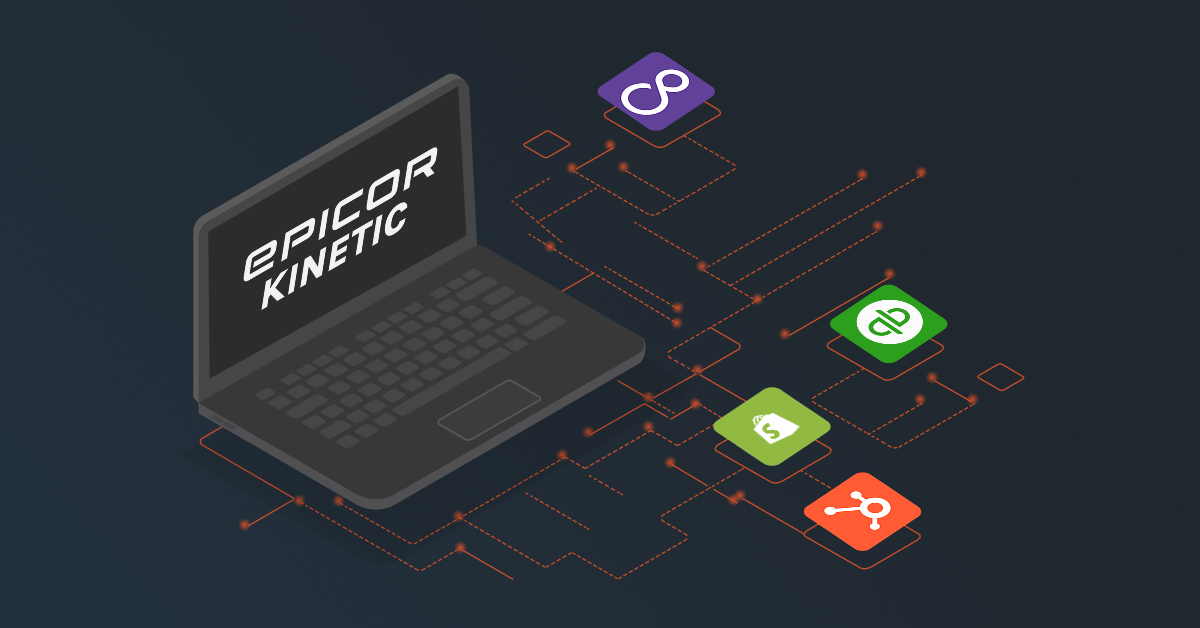
With DCKAP Integrator, Epicor Kinetic can remin at the center of the technology stack and act as the operational source of truth. Your ecommerce platform and other business applications connect to Kinetic through the integration layer, allowing data to move between different systems without creating separate point-to-point connections for every application.
With a managed approach, your team can spend less time worrying about:
- Building and maintaining API connections
- Managing data mappings
- Monitoring integration failures
- Troubleshooting sync issues
- Updating integrations when requirements change
- Managing ongoing technical maintenance
Instead, you have a dedicated integration team supporting the connection and helping keep data moving between Epicor Kinetic and your ecommerce platform.
For businesses that want Epicor Kinetic to remain the center of their operations without taking on the technical burden of managing the integration themselves, a managed platform like DCKAP Integrator provides a more hands-off way to connect ecommerce with the ERP.
If this sounds like what you need, get in touch with us to see how Epicor Kinetic ecommerce integration can work for your business.
FAQs
What are the benefits of integrating Epicor Kinetic with an ecommerce site?
Epicor Kinetic ecommerce integration can improve efficiency, accuracy, and speed by reducing manual and error-prone tasks. It can also support better inventory management, order management, and customer experience while giving employees more time to focus on higher-value work.
Can Epicor Kinetic integrate with CRM and other business systems?
Yes. Epicor Kinetic can be connected with CRM platforms, ecommerce sites, marketplaces, WMS, shipping systems, and other applications. Using an integration platform can help businesses connect these different data sources and create a more seamless flow of information.
What are the best practices for Epicor Kinetic ecommerce integration?
Start by identifying which system should be the source of truth for each type of data. Then define the data to be synchronized, determine which information needs real-time updates, clean existing data, establish validation rules, and plan for monitoring and error handling. Testing the workflows before going live is also important.
How does integration support supply chain management?
Connecting Epicor Kinetic with ecommerce and other systems gives teams better visibility into orders, inventory, fulfillment, and shipping processes. This can help reduce unnecessary delays and waste and give teams more information to manage the supply chain.
What questions should a business ask before integrating Epicor Kinetic with ecommerce?
Businesses should consider:
- Which data needs to be synchronized?
- Which system should be the source of truth?
- Which data needs real-time data synchronization?
- How will errors be detected and handled?
- How many ecommerce sites or marketplaces need to connect?
- Are there customer-specific pricing or inventory rules?
- Who will manage the integration after implementation?
- What level of support and maintenance will be required?